

 (360) 896-2829
When Sealing Your Home Makes More Financial Sense Than You Might Think
When sealing your home makes more financial sense is a question worth asking before spending thousands on new windows, siding, or a full HVAC replacement. The short answer: air sealing typically delivers the fastest payback and highest return of almost any home improvement you can make — especially in Southwest Washington, where heating season is long and energy costs add up fast.
Here’s a quick look at when sealing makes the strongest financial case:
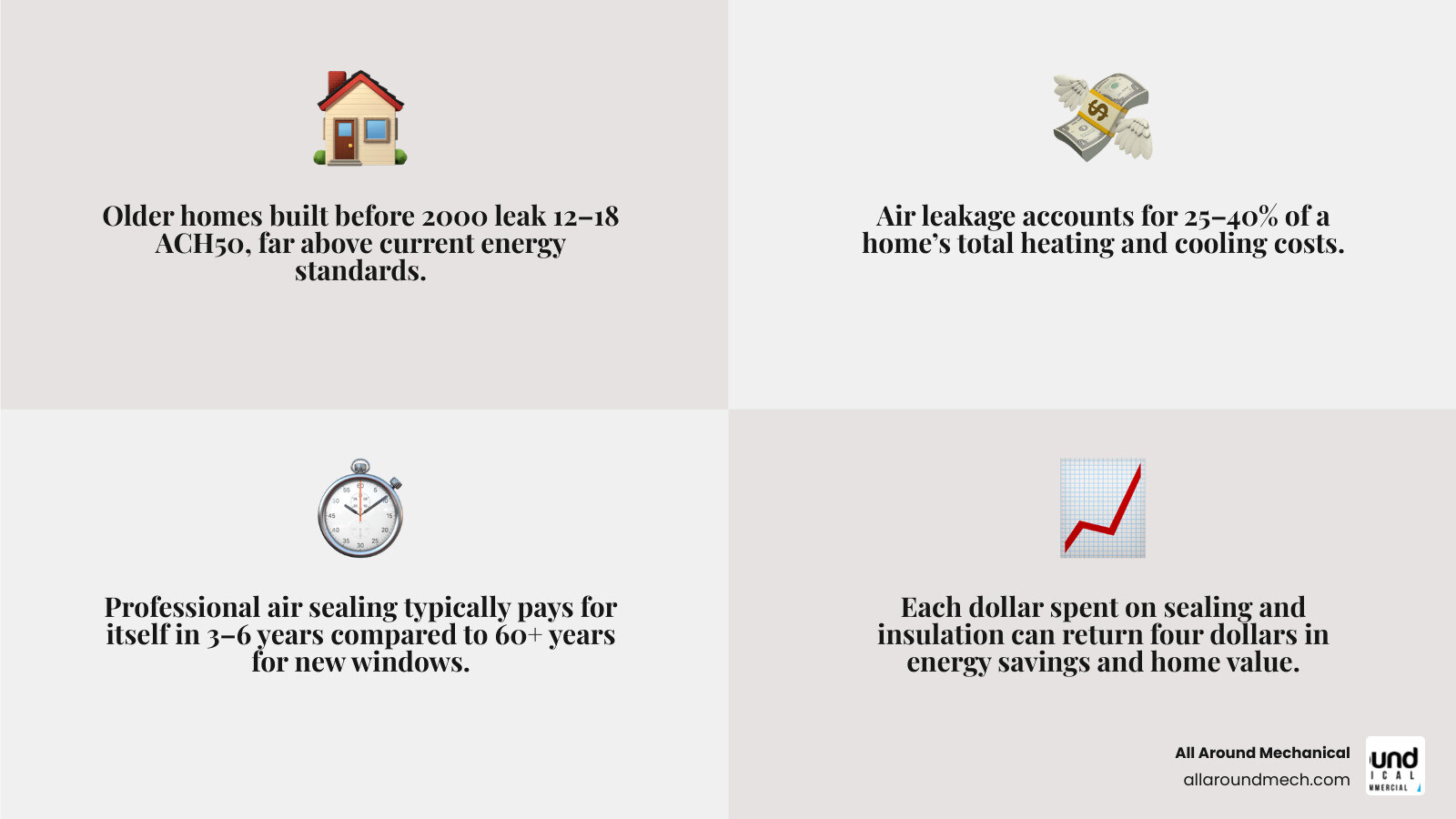
- Your home was built before 2000. Older homes average 12–18 air changes per hour (ACH50), meaning they leak far more than current standards allow.
- Your heating and cooling bills feel too high. Air leakage accounts for 25–40% of a home’s heating and cooling costs.
- You’re considering window replacement first. New windows can take 60+ years to pay back through energy savings alone, while professional air sealing can pay for itself in 3–6 years.
- You’re planning to sell. Well-sealed, well-insulated homes sell for 2–3% more than comparable listings.
- You haven’t had an energy audit. A blower door test can reveal exactly how much air your home is losing — and where.
- You have inconsistent room temperatures or noticeable drafts. These are classic signs of a leaky building envelope, not an undersized HVAC system.
Think of it this way: imagine leaving a window open 24 hours a day, 365 days a year. That’s roughly what a typical older home experiences through gaps, cracks, and unsealed penetrations. Sealing those leaks is the foundation of an energy-efficient home — and it costs far less than most other upgrades while delivering outsized returns.
According to the U.S. Department of Energy, homeowners can save up to 30% on annual heating and cooling costs by combining air sealing with insulation improvements. And each dollar invested in sealing and insulation can return four or more dollars in combined energy savings and increased home value over time.
The sections below break down exactly how to evaluate whether air sealing makes financial sense for your specific situation — including how it compares to other common upgrades, what factors affect your ROI, and what incentives are available to Washington homeowners right now.
Understanding the Difference: Air Sealing vs. Insulation

Many homeowners confuse air sealing with adding insulation, often believing that a thick layer of attic insulation is enough to stop drafts. While both are critical components of a comfortable home, they serve entirely different functions. Understanding how they work together is key to maximizing your energy savings.
Insulation acts as your home’s thermal boundary. It is designed to resist conductive heat transfer—the movement of heat directly through solid materials like wood, drywall, and glass. Insulation is measured by its R-value, which rates its thermal resistance.
Air sealing, on the other hand, establishes your home’s pressure boundary. It stops convective heat loss, which is the movement of heat carried by moving air. When warm air escapes through cracks and gaps in your ceiling, floor, or walls, cold outdoor air is drawn in to replace it.
To make this simple, we like to use the windbreaker analogy. Imagine going outside on a cold, breezy winter day in Ridgefield, WA, wearing a thick, fuzzy wool sweater. The sweater represents your insulation. It keeps you warm by trapping air within its fibers. However, if a strong gust of wind blows, that cold air will pass right through the gaps in the wool, chilling you instantly. To stay warm, you need to put a windbreaker over the sweater. The windbreaker represents air sealing. By stopping the movement of air, it allows the insulation to do its job effectively.
If you insulate your attic without sealing the air leaks first, warm air from your living space will simply bypass the insulation through plumbing chases, electrical penetrations, and light fixtures. This convective airflow can reduce your insulation’s actual performance by 30% to 50%. This is why we always recommend addressing the pressure boundary first.
When you establish a continuous air barrier, you protect your insulation from air currents, prevent moisture from condensing in your attic, and ensure your home stays comfortable year-round. To explore the best methods for achieving this airtight boundary, check out The Great Air Sealing Showdown Between Aerobarrier and Traditional Methods and learn How a Tighter Building Envelope Saves You Money and Energy.
When Sealing Your Home Makes More Financial Sense Than Other Upgrades
When deciding how to allocate your home improvement budget, it is easy to get distracted by high-profile projects. Upgrades like brand-new double-pane windows, a new roof, or fiber-cement siding certainly add curb appeal, but how do they compare financially to a professional air sealing and insulation package?
Let’s look at the numbers. While window replacement is a popular choice for drafty homes, it is rarely justified by energy savings alone. Replacing a full set of old windows is a significant financial investment, yet it typically saves only a modest amount on annual utility bills. This results in an incredibly long payback period—often exceeding 60 years.
In contrast, professional air sealing and attic insulation upgrades are highly cost-effective. These targeted weatherization projects stop the vast majority of convective energy loss for a fraction of the cost of major exterior remodeling. By stopping air leaks, you can achieve a rapid payback period, often returning your initial investment in just 3 to 6 years through lower monthly utility bills.
Furthermore, sealing your home has a direct impact on your HVAC system. A leaky house requires a larger, more expensive heating and cooling system to keep up with the constant infiltration of outdoor air. By sealing the building envelope first, you reduce your home’s heating and cooling load. This means that when it comes time for an HVAC replacement, you can install a smaller, more efficient system, saving you money on both the upfront equipment purchase and long-term operating costs.
To see how these savings fit into your broader home improvement plans, take a look at our guide on Calculating the ROI of Your Next HVAC Upgrade.
| Home Upgrade | Estimated Cost Recovery at Resale | Payback Period (Energy Savings) | Primary Benefit |
|---|---|---|---|
| Air Sealing & Insulation | 76% – 100%+ | 3 – 6 Years | Maximum comfort, lowest energy bills, smaller HVAC sizing |
| Garage Door Replacement | 87% – 194% | N/A | High curb appeal, minor garage draft reduction |
| Fiber-Cement Siding | 83% – 88% | N/A | Exterior durability, aesthetics |
| Minor Kitchen Remodel | 74% – 96% | N/A | High daily enjoyment, strong buyer appeal |
| HVAC Heat-Pump Upgrade | 67% – 100%+ | 5 – 10 Years | Efficient year-round comfort, lower utility bills |
| New Roof (Asphalt Shingles) | 57% – 109% | N/A | Crucial structural protection, high buyer confidence |
| Vinyl Window Replacement | 65% – 67% | 60+ Years | Noise reduction, easier operation, low energy ROI |
Key Factors That Determine Your Return on Investment
While air sealing is generally a smart financial move, your actual return on investment depends on several unique characteristics of your property. Not every home will experience the exact same percentage of savings, but certain factors make the financial case for sealing incredibly compelling.
How Climate and Home Age Influence When Sealing Your Home Makes More Financial Sense
Our local marine climate in Southwest Washington features long, damp winters and increasingly warm summers. Because we rely heavily on our heating systems for many months of the year, any heated air that leaks out of your home is a direct loss of money.
The age of your home is one of the strongest indicators of how much you stand to save. Homes built before 2000 were constructed under much more lenient energy codes. These properties commonly measure between 12 and 18 Air Changes per Hour at 50 Pascals (ACH50). This means that under normal pressure, the entire volume of air inside the home escapes and is replaced by outdoor air more than a dozen times every hour! By comparison, modern 2026 building standards aim for a much tighter envelope, typically under 3 to 5 ACH50.
Older homes suffer severely from the stack effect. This is a natural physical process where warm indoor air rises and escapes through cracks in the attic ceiling (the top plates, recessed lights, and plumbing chases). As this warm air escapes, it creates a negative pressure zone at the bottom of the house, which sucks cold, damp air in through the crawlspace, basement, and floorboards. If your home has cold spots or drafty floors, the stack effect is the culprit. Sealing these leaks stops this continuous loop of energy waste. You can read more about eliminating these uncomfortable drafts in Say Goodbye to Cold Spots with Aerobarrier Air Sealing.
How Existing Insulation and Ductwork Affect When Sealing Your Home Makes More Financial Sense
Another critical factor is the condition of your existing insulation and ductwork. If your attic floor is covered in loose-fill fiberglass or cellulose but has never been air-sealed, the insulation is essentially sitting on top of a sieve. Warm air will easily drift right through the insulation fibers, rendering it far less effective.
Additionally, your ductwork plays a major role in your home’s pressure dynamics. If your air ducts run through unconditioned spaces like a drafty attic or a damp crawlspace, any leaks in those ducts will pull dirty, unconditioned air into your living areas or blow your expensive heated air directly outside. According to industry statistics, the average home loses 15% to 30% of its conditioned air through duct leakage before it ever reaches the registers.
By sealing both your home’s building envelope and your duct system, you protect your indoor air quality and ensure your heating and cooling systems operate at peak efficiency. To learn more about how leaky ducts waste money, check out Stop Throwing Money into Your Attic with These Duct Leak Facts and discover how to seal them permanently with Breathe Easy and Save Big with Aeroseal Duct Sealing.
Assessing Your Home’s Sealing Needs Before Listing
If you are preparing to list your home for sale in Southwest Washington, you might be wondering which pre-sale upgrades will help you secure the highest offer. While cosmetic updates are important, modern home buyers are increasingly focused on energy efficiency and low utility costs. In fact, national surveys show that heating and cooling efficiency is one of the most desirable “green” features for prospective buyers.
Homes with outstanding insulation and professional air sealing sell for an average of 2% to 3% higher than comparable, unsealed listings. Investing in weatherization before selling not only increases your property value but also provides a distinct competitive advantage. A home that has been professionally sealed signals to buyers and home inspectors that the property has been meticulously cared for, reducing the likelihood of post-inspection objections or demands for repair credits.
To assess whether your home needs air sealing before listing, look for these common warning signs:
- Visible gaps around window frames, baseboards, and exterior doors.
- Discolored or dirty insulation in the attic, which indicates that dusty indoor air is filtering up through gaps in the ceiling drywall.
- Inconsistent room-to-room temperatures and persistent drafts on windy days.
- Frequent pest intrusions, as insects and spiders often use air leakage pathways to enter your home.
The most accurate way to evaluate your home’s airtightness is through a professional energy audit that includes a blower door test. This test uses a powerful calibrated fan mounted in an exterior doorway to depressurize your home. By pulling air out of the house, it forces outdoor air in through all the hidden cracks and gaps, allowing a technician to locate leaks using thermal imaging cameras or smoke pencils.
Providing prospective buyers with documented before-and-after blower door test results is a fantastic marketing tool that proves your home is comfortable, durable, and highly efficient. For more insights on how these improvements boost your market value, read Why Upgrading Your Air is a Breath of Fresh Air for Your Home Value and review A Quick Start Guide to HVAC Impact on Home Appraisals.
Frequently Asked Questions About Home Air Sealing
Can a home be sealed too tightly?
This is a common concern among homeowners. While it is possible to make a home incredibly airtight, the saying in our industry is: “Build tight, ventilate right.”
When a home is sealed to a very high standard—typically tighter than 3 ACH50—it requires mechanical ventilation to ensure a continuous supply of fresh, filtered outdoor air. This is easily managed by installing balanced ventilation systems like Energy Recovery Ventilators (ERVs) or Heat Recovery Ventilators (HRVs), which exhaust stale indoor air while pre-heating or pre-cooling the incoming fresh air.
Another critical safety consideration is combustion safety. If your home has atmospherically vented gas appliances, such as an older natural gas water heater or furnace, sealing the home too tightly can create a risk of backdrafting. This occurs when exhaust fans pull combustion gases, including dangerous carbon monoxide, back down the chimney and into your living spaces. Working with a certified professional ensures that proper combustion safety testing is performed before and after sealing, keeping your family safe.
How long do professional air sealing improvements last?
Professional air sealing is a highly durable upgrade. High-quality polyurethanes, silicone caulks, and specialized expanding foam sealants used during installation typically last between 20 and 30 years or more. Unlike mechanical equipment that eventually wears out and requires replacement, a sealed building envelope continues to save you money silently for decades.
While weatherstripping on high-traffic exterior doors and windows may need to be touched up or replaced every 5 to 10 years due to physical wear and tear, the vast majority of the sealed pathways—hidden in your attic, crawlspace, and rim joists—remain completely undisturbed. To get a clear picture of what the installation process looks like, read through our guide on What to Expect When You Are Aerobarriering Your House.
Are there rebates or tax credits available for air sealing in Washington?
Yes! There are excellent financial incentives available that make air sealing even more attractive. Under the federal Energy Efficient Home Improvement Credit (Section 25C), homeowners can claim a tax credit of up to 30% of the cost of air sealing and insulation materials, up to a maximum annual credit of $1,200.
Additionally, local utility companies serving Southwest Washington offer various weatherization rebates for qualifying professional air sealing and insulation projects. The federal HOMES rebate program also provides additional incentives for energy-saving retrofits, particularly for projects that achieve verified reductions in home energy use through pre- and post-installation blower door testing.
Conclusion
For homeowners in Southwest Washington—from Vancouver and Ridgefield to Camas, Battle Ground, and Longview—maximizing energy efficiency is the smartest way to keep utility bills under control while enjoying a cozy, draft-free indoor environment.
When you look at the long payback periods of other major exterior renovations, it becomes clear that establishing a tight, well-insulated building envelope is where your hard-earned money should go first. By stopping convective heat loss, you protect your home from moisture damage, improve your indoor air quality, and set your heating and cooling systems up for a long, efficient life.
If you are ready to stop wasting energy and start enjoying a truly comfortable home, we are here to help. Our team of certified professionals specializes in advanced air sealing and indoor air quality solutions tailored to our unique local climate.
To learn more about the return on investment you can expect, read our Aerobarrier ROI and Comfort Guide for Homeowners, and Schedule your Aerobarrier consultation today to take the first step toward a high-performance home.