

 (360) 896-2829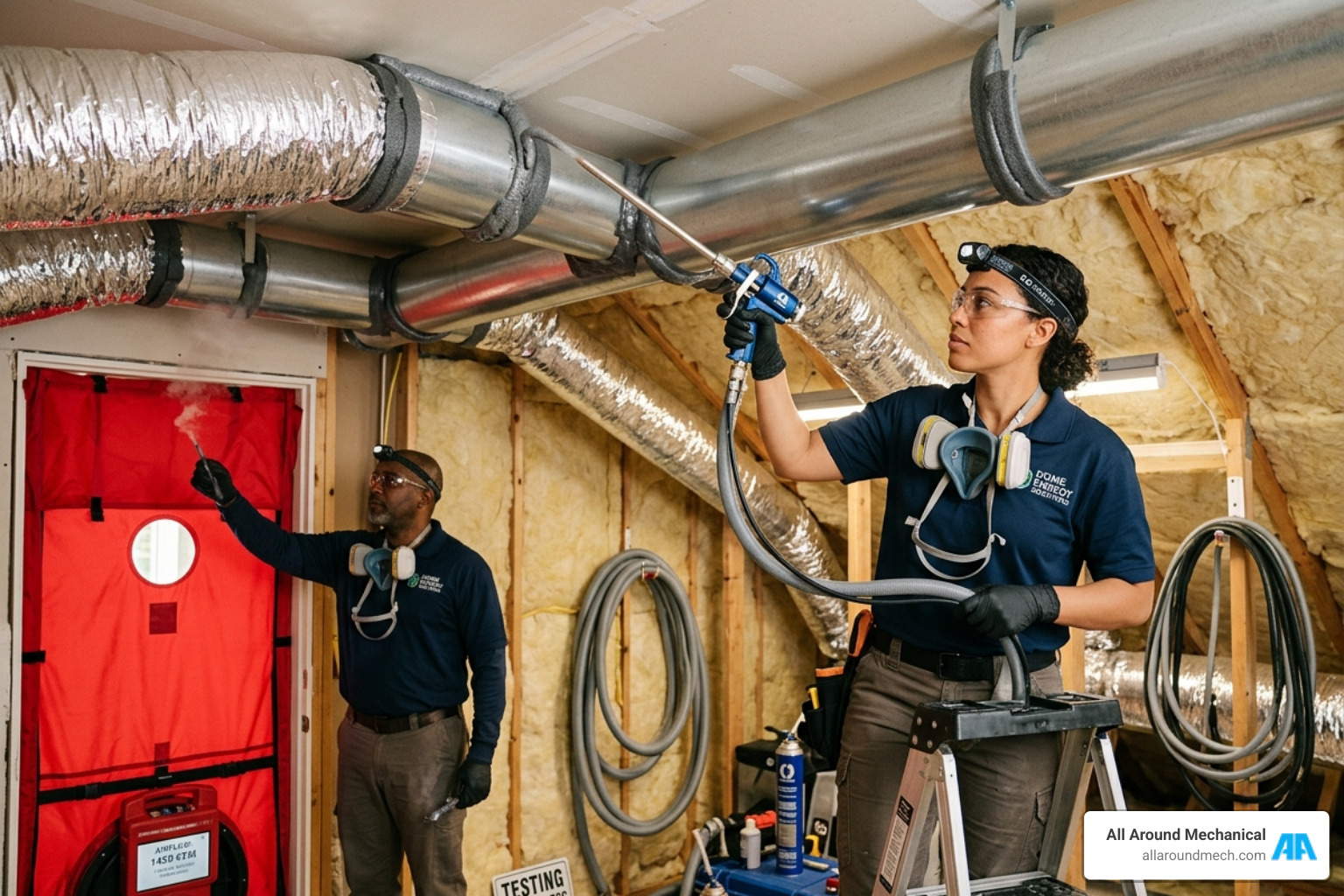
Is Aeroseal or AeroBarrier Worth the Investment for Vancouver, WA Homeowners?
Is Aeroseal or AeroBarrier worth the investment? Yes — for most homeowners and builders, both technologies deliver strong, measurable returns. Here’s a quick summary:
Quick Answer:
- Energy savings: Homeowners typically save 20–30% on utility bills after sealing
- ROI timeline: Most homeowners recoup their investment in 2.5 to 5 years
- Durability: Seals are tested to last 40+ years with a 10-year warranty
- Speed: The sealing process takes just 60–90 minutes
- Safety: Non-toxic, low-VOC, water-based sealant — safe for families and pets
- Best for new construction: AeroBarrier seals the full building envelope before or after drywall
- Best for existing homes: Aeroseal targets ductwork leaks from the inside without demolition
- Certifications: Supports ENERGY STAR, LEED, Passive House, and Net Zero standards
The U.S. Department of Energy estimates that 25–40% of home energy use is lost through air leaks. That’s not a small problem — it’s a significant drain on your comfort and your wallet, every single month. In Southwest Washington, where heating demands are real and energy costs keep climbing, those losses add up fast.
Most homeowners in Vancouver, WA and the surrounding area don’t realize their ducts or building envelope are leaking conditioned air — often in places no one can see or reach by hand. The result? Uneven temperatures, dusty rooms, strained HVAC equipment, and utility bills that never seem to come down.
That’s exactly the problem that Aeroseal duct sealing and AeroBarrier whole-home envelope sealing were designed to solve. Both use an aerosolized sealant technology that finds and plugs leaks from the inside — no demolition, no guesswork, and no relying on manual caulking to reach every hidden gap.
This guide breaks down how each technology works, what kind of savings and ROI you can realistically expect, and whether the investment makes sense for your home or project.

Understanding the Technology: How Aeroseal and AeroBarrier Work
At the heart of both systems is a clever bit of building science. Instead of a technician crawling through a cramped attic or tearing out drywall to find a leak, we use the physics of air pressure to do the work.
The Physics of Aerosol Sealing
Imagine a balloon with a tiny pinhole. If you blow air into it, that air is going to find the hole and rush out. Now, imagine that the air you’re blowing in is filled with microscopic particles of sealant. As the air escapes through the hole, those particles are pulled along with it. They hit the edges of the leak, stick, and begin to “bridge” the gap.
Aeroseal focuses specifically on your HVAC ductwork. We block off the registers and vents, then pressurize the duct system. A non-toxic, water-based aerosol is injected into the ducts. These particles remain suspended in the air until they reach a leak—whether it’s a loose joint behind a wall or a crack in the furnace plenum. The sealant builds up, creating an airtight bond that can seal gaps up to 5/8 of an inch.
AeroBarrier takes this same concept and applies it to the entire “envelope” or shell of your home. It’s a computer-controlled system that pressurizes the whole house. As the aerosolized sealant is released into the rooms, it seeks out every crack and crevice—around window frames, electrical outlets, and baseboards—sealing leaks as small as a human hair.
The sealant itself is a vinyl acetate polymer—the same kind of stuff you’d find in chewing gum or hairspray. It’s safe, durable, and incredibly effective. For those interested in the specifics of the envelope sealing process, you can find more info about AeroBarrier services here.
Is Aeroseal or AeroBarrier Worth the Investment for Energy Savings?
When homeowners ask us is aeroseal or aerobarrier worth the investment, they are usually looking at the bottom line. In Southwest Washington, where we deal with chilly winters and increasingly smoky summers, the value goes beyond just the monthly bill, but the financial data is hard to ignore.
Direct Energy Savings
Research shows that up to 50% of the energy used for HVAC in a building is wasted through leaks. By sealing those gaps, you are ensuring that the air you paid to heat actually reaches your living room instead of escaping into the crawlspace.
- Residential Duct Sealing: Can save up to 30% on energy bills.
- Envelope Sealing: Homes meeting modern energy codes through envelope sealing can save up to $700 annually on energy bills.
Return on Investment (ROI)
The average ROI for an Aeroseal or AeroBarrier treatment is typically realized within 2.5 to 5 years. In the Northwest, where utility rates and climate factors play a role, homeowners often see annual savings between $600 and $900.
Extending HVAC Lifespan
Beyond the bills, there is the “hidden” ROI: the longevity of your equipment. When your home is leaky, your furnace or heat pump has to work twice as hard to maintain the temperature. This leads to premature wear and tear. By sealing the home, you reduce the “fan requirements” and overall load on your system, which can significantly extend its lifespan. For more details on how this impacts your specific setup, check more info about AeroBarrier services.
Comparing Advanced Air Sealing to Traditional Methods
For decades, “air sealing” meant a tube of caulk, some cans of spray foam, and a lot of luck. While manual methods have their place, they are fundamentally limited by what the human eye can see and what the human hand can reach.
| Feature | Manual Sealing (Caulk/Tape/ADA) | Aerosol Technology (Aeroseal/AeroBarrier) |
|---|---|---|
| Precision | Limited to visible gaps | Seals leaks as small as a human hair |
| Accessibility | Cannot reach leaks behind walls/ceilings | Reaches every leak the air can reach |
| Verification | Guesswork | Real-time computer monitoring & data |
| Speed | Days of labor-intensive work | 60–90 minutes of sealing time |
| Effectiveness | Often misses 40-60% of hidden leaks | Seals 90-95% of total leakage |
| Consistency | Highly dependent on installer skill | Computer-guided and automated |
The “Airtight Drywall Approach” (ADA) is a common manual method used in new construction, but it relies on gaskets and tapes that can fail as a house settles. In contrast, the aerosol sealant has a 30% flex rating, meaning it stays intact even as your home moves over the decades.
If you’re wondering if these advanced methods are a better fit for your project than traditional taping and mastic, you can find more info about AeroBarrier services to help you decide.
Frequently Asked Questions about Air Sealing ROI
Is aeroseal or aerobarrier worth the investment for older homes?
Absolutely. In fact, older homes often see the most dramatic improvements. Over time, ducts pull apart, and building materials shrink, creating massive air loss. We’ve seen older homes in the Vancouver area with air leakage rates that make the HVAC system almost useless.
Retrofitting an older home with Aeroseal or AeroBarrier can:
- Reduce Drafts: No more cold spots near windows or outlets.
- Improve Air Quality: It stops “attic air” or “crawlspace air” (filled with dust and allergens) from being pulled into your living space.
- Reduce Dust: Less air infiltration means less outdoor pollutants settling on your furniture.
For homeowners in places like Battle Ground or Camas with historic or mid-century homes, this is often the most cost-effective way to modernize comfort. More info about AeroBarrier services is available for those looking to retrofit.
Is aeroseal or aerobarrier worth the investment for new construction?
For builders and those custom-building in Ridgefield or Washougal, these technologies are game-changers. Meeting the 2021 IECC (International Energy Conservation Code) or aiming for ENERGY STAR, LEED, or Passive House certifications can be stressful.
Using AeroBarrier allows you to:
- Pass Blower Door Tests: Get a guaranteed result the first time, avoiding costly re-testing.
- Achieve High Performance: We’ve seen projects achieve 1 ACH50 (air changes per hour), which is incredibly airtight.
- Save Labor: It takes a fraction of the time compared to manual sealing.
If you are a builder looking to meet strict green certifications, more info about AeroBarrier services can show you the path to compliance.
How long does the sealing process take and how durable is it?
The actual sealing phase is remarkably fast—usually between 60 and 90 minutes. Including setup and prep, a whole-home treatment is often completed in less than a day.
In terms of durability, this isn’t a temporary fix. The sealant is stress-tested to last over 40 years. It is:
- Non-toxic and Low-VOC: Safe for families immediately after the process.
- GreenGuard Gold Certified: Meeting the strictest standards for indoor air quality.
- Odorless: There is a very mild scent (like Elmer’s glue) during application, but it dissipates within hours.
Learn more about the longevity and safety of the process by visiting more info about AeroBarrier services.
Conclusion
When you look at the data—the 30% utility savings, the 90%+ reduction in air leakage, and the long-term protection of your HVAC equipment—the answer to is aeroseal or aerobarrier worth the investment becomes clear. For homeowners in Vancouver, WA and throughout Southwest Washington, it is one of the most effective ways to buy back your comfort and stop wasting energy.
At All Around Mechanical, we are committed to providing Ridgefield, Vancouver, and the surrounding communities with exceptional service that prioritizes your satisfaction. Whether you are building a new home in La Center or trying to make your existing home in Longview more efficient, we have the expertise to help you achieve an airtight, comfortable environment.
Don’t let your hard-earned money leak out through the cracks in your walls or ducts. We pride ourselves on offering these advanced solutions at competitive prices, ensuring that every family in our service area can breathe easier and save more.
Ready to see the difference for yourself? Contact All Around Mechanical for AeroBarrier services and take the first step toward a more efficient home today.