

 (360) 896-2829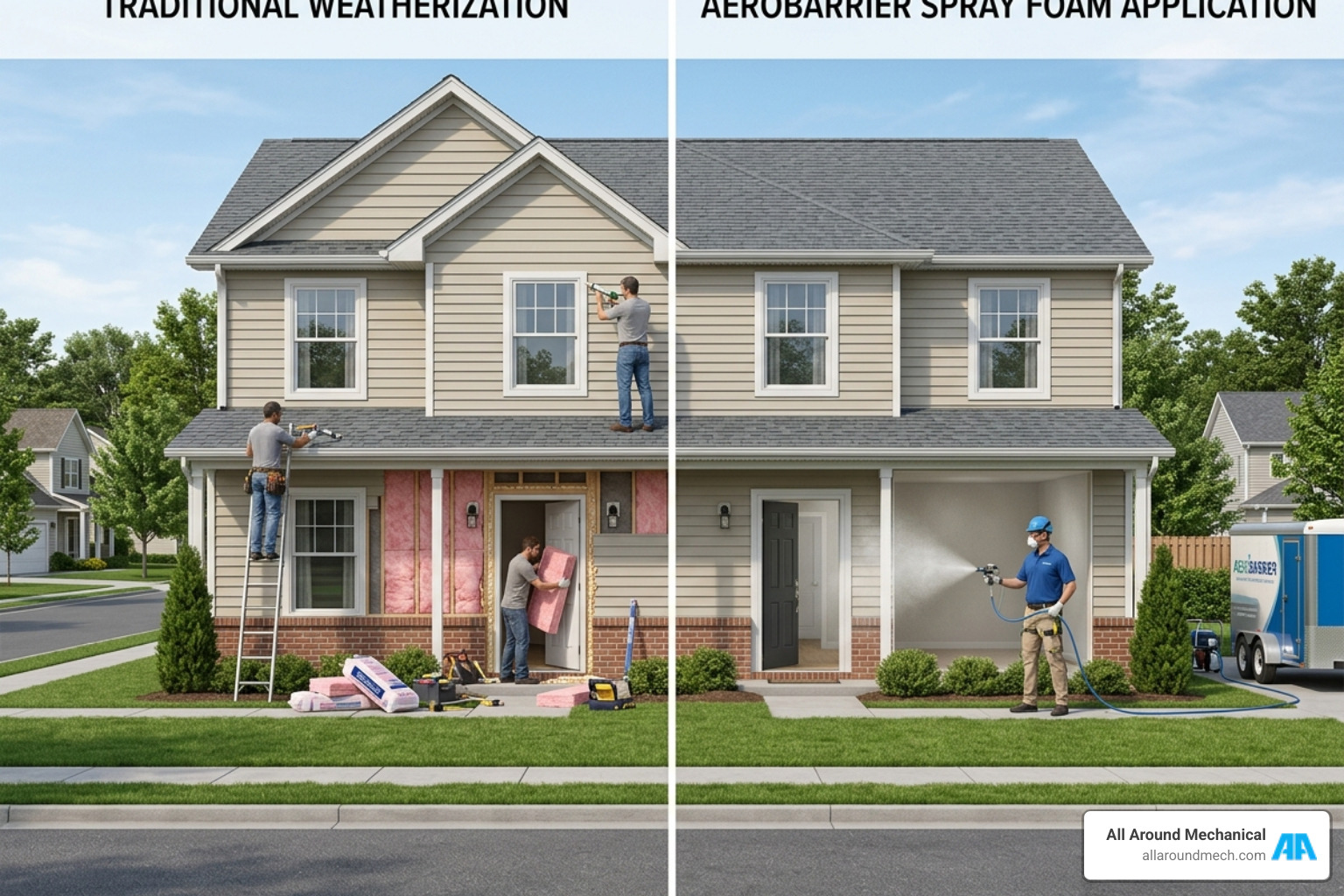
Understanding the Aerobarrier vs Traditional Weatherization Comparison
When we look at the aerobarrier vs traditional weatherization comparison, we are essentially looking at a battle between manual labor and automated physics. Traditional weatherization is a “hunt and peck” method. A technician walks through a home with a caulk gun, cans of spray foam, and rolls of weatherstripping, looking for visible gaps. They seal the attic hatch, the rim joists, and the spaces around windows. While this is helpful, it is inherently limited by human eyesight and physical reach. Many of the most significant leaks in a home are located in places a human simply cannot see or reach, such as the gaps between top plates and drywall or the tiny fissures inside wall cavities.
AeroBarrier, on the other hand, doesn’t guess where the leaks are. It uses the building’s own pressure to find them. By turning the entire house into a pressurized vessel, the system forces air out through every single crack, nook, and cranny. When the aerosolized sealant is released, it simply follows that air, finding the path of least resistance just as a draft would. This ensures that even the most obscure bypasses—those that contribute to high energy bills but remain hidden behind finished surfaces—are permanently closed.
The Mechanics of Aerosol vs. Manual Application
The process begins by using a blower door to pressurize the home to approximately 100 Pascals. This is significantly higher pressure than a standard blower door test, ensuring that air is pushing through even the tightest gaps. We then activate the computer-controlled emitters. These nozzles release a mist of sealant particles that are specifically calibrated to remain in suspension until they are pulled toward a leak.
These particles are designed to stay suspended in the air unless they encounter a leak. As the air rushes out of a crack—perhaps one as thin as a human hair or as wide as a half-inch—the sealant particles collide with the edges of the opening. They stick, build up, and eventually create a permanent, airtight seal. In a traditional weatherization approach, a worker might spend hours trying to foam a plumbing penetration, only to miss the tiny bypasses in the wall cavity. AeroBarrier seals those automatically, providing a level of comprehensive coverage that manual application cannot replicate.
Speed and Precision: How Aerosol Sealing Outperforms Manual Labor
Time is a major factor for our customers in Vancouver, Ridgefield, and Camas. Traditional air sealing is labor-intensive. It often requires multiple stages: an initial seal, a blower door test to find what was missed, and then a “return trip” to fix those remaining leaks. This can drag on for days or even weeks in complex new construction projects, potentially delaying other trades like drywall or painting.
AeroBarrier changes the timeline completely. The actual sealing phase usually takes only 60 to 90 minutes. Including setup and teardown, we can often complete an entire single-family home in one working day. Because the system provides real-time monitoring, we don’t have to guess if we’ve hit the target. We can see the ACH50 (Air Changes per Hour at 50 Pascals) dropping on a tablet right before our eyes. This immediate feedback allows us to meet specific performance goals, such as the stringent requirements for Washington State energy codes, without the need for repeated testing and re-work.

Achieving Superior Results in an Aerobarrier vs Traditional Weatherization Comparison
The data speaks for itself. In a aerobarrier vs traditional weatherization comparison, the levels of airtightness achieved are often night and day. For example, production builders like Mandalay Homes have consistently achieved 0.3 ACH50 across dozens of homes using this technology. To put that in perspective, many modern building codes only require 3.0 or 5.0 ACH50. Achieving a 0.3 rating with manual caulking alone is nearly impossible on a consistent basis.
Even in renovations, the impact is massive. A Department of Defense study showed that AeroBarrier reduced air leakage by as much as 80% in older buildings—results that are nearly impossible to achieve with manual caulking alone. In one research project, an experienced three-man weatherization crew spent eight hours manually sealing a home and only reduced the leakage by 0.15 ACH50. AeroBarrier can achieve many times that reduction in a fraction of the time, making it the most efficient choice for homeowners looking to maximize their energy savings quickly.
Long-Term Performance: Durability and Indoor Air Quality
We often get asked how long these seals actually last. The sealant used is a specialized, non-toxic, water-based acrylic. It is Greenguard Gold certified, meaning it meets some of the world’s most rigorous standards for low chemical emissions. Once it hardens, it is rated to maintain its integrity for 50 years or more. Unlike some traditional caulks that can dry out, shrink, and crack as a house settles over the seasons, this sealant remains durable and flexible enough to maintain the envelope’s integrity.
A tighter building envelope isn’t just about saving money; it’s about health. When a home is leaky, it draws in unfiltered air from crawlspaces, attics, and wall cavities. This air often carries dust, allergens, and moisture. In the damp climate of Southwest Washington, moisture control is particularly important. A leaky house allows humid outdoor air to infiltrate wall cavities, where it can condense on cold surfaces and lead to mold growth. By creating a tight seal, we ensure that the only air entering your home is coming through your high-quality filtration and ventilation systems.
Why Homeowners Prefer Aerobarrier vs Traditional Weatherization Comparison for Retrofits
For those living in historic homes in areas like Washougal or Longview, AeroBarrier offers a unique advantage. Traditional air sealing often requires “invasive” measures—ripping out drywall or siding to reach the structural gaps. AeroBarrier can seal these invisible leaks from the inside without destroying the historic fabric of the building. This allows homeowners to preserve the aesthetic charm of an older property while enjoying the comfort and efficiency of a modern high-performance home.
In occupied retrofits, we take extra care to protect surfaces. We mask off finished floors, windows, and horizontal surfaces. Because the sealant is non-toxic and low-VOC, families can typically re-enter the home shortly after the process is complete and the space has been ventilated. It addresses the “stack effect” (where heat escapes out the top of the house and pulls cold air in through the bottom) far more effectively than manual weatherstripping ever could, eliminating those stubborn drafts that make winter nights uncomfortable.
Real-World Impact: Energy Efficiency and ROI
The return on investment (ROI) for advanced air sealing is among the highest in the energy efficiency world. A study in Utah found that every $1 spent on energy engineering like this yields at least a 10X ROI in operational savings over the life of the building. In a 29-unit apartment complex, AeroBarrier application resulted in a 25.7% reduction in annual energy usage, saving over 116,000 kWh of electricity per year. These savings are consistent across various climates, including the temperate but often chilly winters of the Pacific Northwest.
For homeowners in Southwest Washington, this means lower utility bills and a smaller carbon footprint. It also makes it much easier to achieve prestigious certifications like ENERGY STAR, LEED, or even the incredibly strict Passive House standards. By sealing the building envelope to such a high degree, homeowners can significantly reduce the energy required to maintain a comfortable indoor temperature year-round.
Supporting High-Performance HVAC Systems
One of the most overlooked benefits of a tight envelope is how it helps your HVAC system. When your home is leaky, your furnace or heat pump has to work overtime to compensate for the “conditioned” air that is constantly escaping. This leads to longer runtimes and more wear and tear on your equipment, eventually shortening its lifespan. Furthermore, a tight envelope allows for the installation of smaller, more efficient heat pumps.
By using AeroBarrier to seal the envelope—and even the duct transitions and mechanical closets—we can often “right-size” the HVAC equipment. A smaller, more efficient system can keep a tight home perfectly comfortable, leading to better humidity control and more uniform temperatures from room to room. No more “hot spots” or drafty corners. When the load on the system is reduced, the equipment can run at lower, more consistent speeds, which is quieter and much more energy-efficient than the constant cycling of an oversized unit in a leaky house.
Frequently Asked Questions about Air Sealing
Is the AeroBarrier sealant safe for my family?
Yes, absolutely. The sealant is a water-based acrylic that is UL Greenguard Gold certified. It contains very low VOCs and has no known off-gassing issues once it has dried. It is the same type of material used in some waterborne paints and even some chewing gums. Most people can return to their homes within a few hours after the process is finished and the home has been aired out.
Can this technology be used in existing homes in Southwest Washington?
Yes, we provide AeroBarrier services for both new construction and retrofits throughout Vancouver, Battle Ground, and Ridgefield. In existing homes, the preparation is more detailed—we must protect furniture and finished surfaces—but the results are often even more dramatic because older homes tend to have much higher initial leakage rates.
Does it guarantee passing a blower door test?
While “guarantee” is a strong word, AeroBarrier is as close as it gets. Because we monitor the ACH50 in real-time, we don’t stop the process until the computer shows we have reached your target goal. This eliminates the “failed test” anxiety that many builders face. We provide a documented report showing the “before” and “after” leakage levels for your records and for building inspectors.
Conclusion
When we weigh the aerobarrier vs traditional weatherization comparison, the choice for modern homeowners is clear. While manual sealing still has its place for large, obvious holes, AeroBarrier provides a level of precision, speed, and verifiable performance that traditional methods simply cannot match. It transforms the way we think about building envelopes, moving from guesswork to a data-driven, automated solution that guarantees results.
At All Around Mechanical, we are dedicated to bringing the best in HVAC and indoor air quality technology to our neighbors in Ridgefield, Vancouver, and throughout Southwest Washington. Whether you are building a new dream home or trying to make an older house more comfortable, we are here to help you achieve a more efficient, healthier living environment. Our team is located at 900 NW Carty Rd, Ridgefield, WA 98642, and we are ready to assist with your next project. Contact us for aerobarrier services today to see how we can transform your home’s performance and comfort.