

 (360) 896-2829
Is HVAC Replacement a Smart Investment for Southwest Washington Homeowners?
HVAC replacement return on investment is one of the most important financial questions a homeowner can ask before committing to a new heating or cooling system. The short answer: yes, it typically pays off — and often in more ways than one.
Here’s a quick breakdown of what you can expect:
| ROI Factor | Typical Range |
|---|---|
| Resale value increase | 5% to 10% of home value |
| Energy bill reduction | 20% to 40% annually |
| Cost recouped at home sale | Up to 30% of installed cost |
| Payback period (energy savings) | 5 to 10 years |
| Overall ROI by system type | 50% to 75% depending on system |
A new system doesn’t just cut your monthly utility bills — it can also make your home more attractive to buyers, help you pass inspections without concessions, and qualify you for federal tax credits and local rebates.
But the actual return you’ll see depends on a lot of moving parts: your current system’s age, your home’s insulation, which system you choose, how it’s installed, and even where you live. For homeowners in Southwest Washington — where mild, wet winters and increasingly warm summers put real demands on heating and cooling equipment — getting this decision right matters.
This guide walks you through exactly how to calculate your own HVAC ROI, what factors drive it up or down, and how to make the smartest possible upgrade decision for your home in the Vancouver, WA area and beyond.
Understanding HVAC Replacement Return on Investment
When we talk about hvac replacement return on investment, we are looking at a combination of immediate savings and long-term equity. Many homeowners in Vancouver, WA wonder if a new furnace or heat pump is just a “sunk cost.” In reality, it is a strategic asset.

Boosting Resale Value
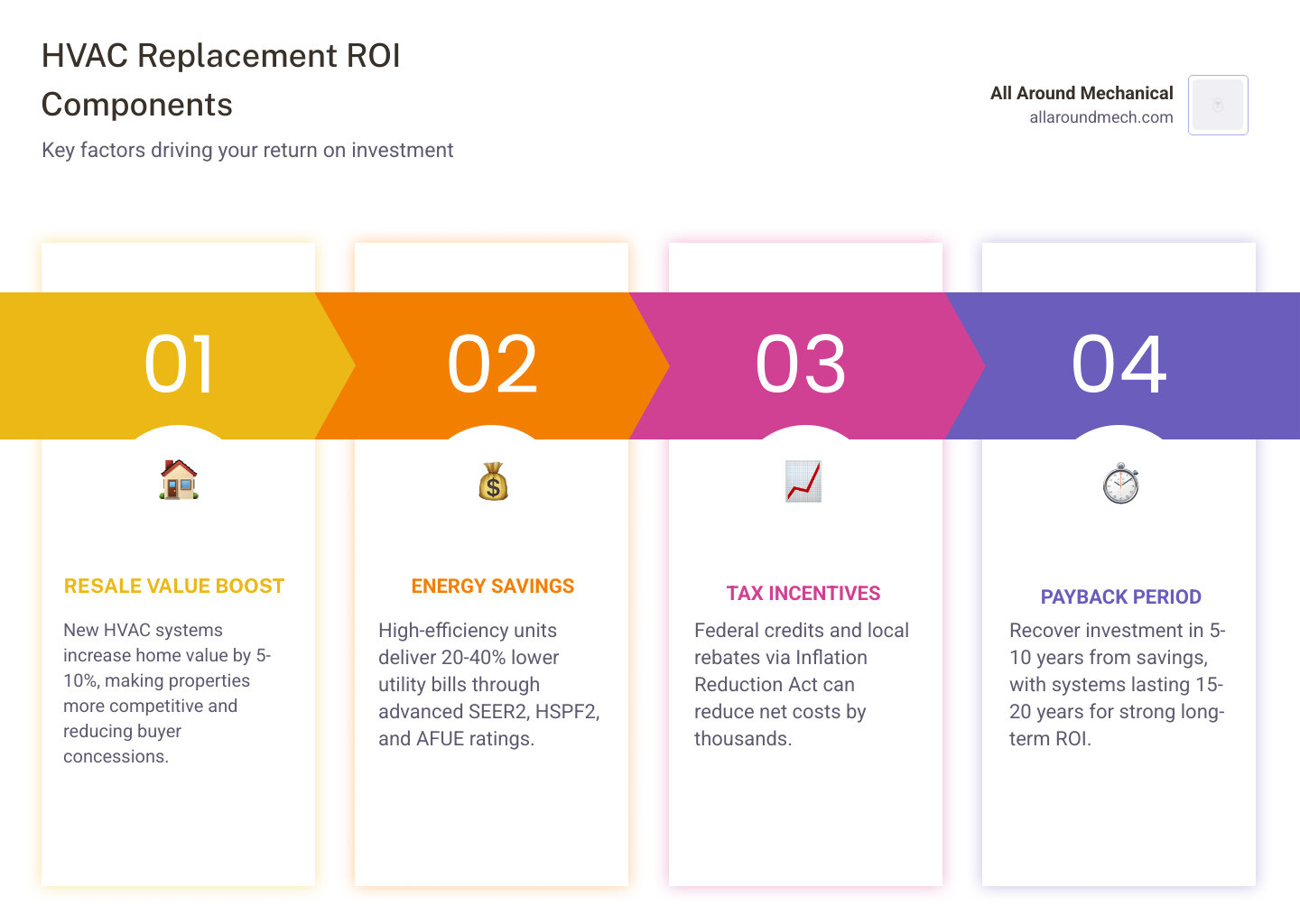
A new HVAC system can increase a home’s value by approximately 5% to 7%. In some competitive markets, this can even reach up to 10%. Why? Because buyers in places like Ridgefield and Battle Ground value peace of mind. When a prospective buyer sees a brand-new, high-efficiency system, they know they won’t be facing a major repair bill in the next decade.
Buyer Psychology and Market Edge
In May 2026, buyers are more energy-conscious than ever. A modern system acts as a “tie-breaker” in a crowded market. If two houses are identical but one has a 20-year-old furnace and the other has a brand-new heat pump, the latter will almost always sell faster and for a higher price. Furthermore, a new system helps you avoid “buyer concessions”—those annoying requests for $5,000 off the price because the inspector flagged the AC as “near end of life.” By recouping costs through a higher sale price, you often find that the system pays for a significant chunk of itself the moment you sign the closing papers.
Comparison to Other Remodels
While a kitchen remodel is flashy, it often only returns about 50-60% of its cost. An HVAC upgrade is a “functional” improvement that appraisers take very seriously. While you can’t cook on a furnace, the 50-75% ROI it offers is often more reliable than a subjective aesthetic upgrade.
Maximizing HVAC replacement return on investment with Efficiency
To get the most out of your investment, you have to look at the numbers—specifically the efficiency ratings.
- SEER2 (Seasonal Energy Efficiency Ratio): This measures cooling efficiency. Moving from an old SEER 10 unit to a modern SEER2 16+ unit can slash cooling costs significantly during our humid Washington summers.
- HSPF2 (Heating Seasonal Performance Factor): Vital for heat pumps, this measures heating efficiency.
- AFUE (Annual Fuel Utilization Efficiency): This is for furnaces. A 95% AFUE furnace means only 5% of the fuel is lost as exhaust.
By upgrading heat pumps to variable-speed models, we can help homeowners achieve 20-40% savings on their annual utility bills. These systems don’t just blast on and off; they ramp up and down to maintain a steady temperature, using the least amount of energy possible.
Factors That Influence Your HVAC ROI in Southwest Washington
Not every HVAC installation is created equal. Several regional and structural factors determine whether your hvac replacement return on investment hits the high or low end of the spectrum.
Regional Climate and Ridgefield Weather
In Southwest Washington, we deal with a “mixed” climate. We need robust heating for the damp winters and reliable cooling for the increasingly hot summer stretches. A system that is perfectly balanced for our specific humidity levels and temperature swings will always provide a better ROI than a generic “one-size-fits-all” unit.
System Sizing and Installation Quality
One of the biggest mistakes we see is improper sizing. If a system is too large, it “short-cycles,” turning on and off constantly, which wears out the motor and kills efficiency. If it’s too small, it runs 24/7 and never gets you comfortable. Proper system sizing requires a Manual J load calculation, which considers your home’s insulation, window types, and square footage. Professional installation ensures that the ductwork is sealed and the refrigerant charge is perfect—factors that can make or break your energy savings.
The Building Envelope
Your HVAC doesn’t work in a vacuum. If your home in Camas or Washougal has poor insulation or leaky windows, even the most efficient heat pump will struggle. We always recommend looking at your home as a complete system. Improving the “envelope” (insulation and air sealing) allows you to install a smaller, less expensive HVAC unit, which boosts your ROI immediately.
How Smart Technology Impacts HVAC replacement return on investment
Modern features aren’t just gadgets; they are financial tools.
- Smart Thermostats: These can save you 10-15% annually by learning your schedule and reducing usage when you’re at work or sleeping.
- Zoning Systems: Why heat the guest room if no one is in it? Zoning allows you to direct comfort only where it’s needed.
- Maintenance Alerts: Many modern systems will text you (or us!) if they detect a performance drop. This allows for preventative care that stops a $200 fix from becoming a $2,000 disaster.
Calculating Your Payback Period and Long-Term Savings
The “payback period” is the amount of time it takes for your energy savings to equal the cost of the upgrade. For most high-efficiency systems in the Vancouver area, this sits between 5 and 10 years.
| System Type | Estimated Annual Savings | Payback Period |
|---|---|---|
| Standard Efficiency | $200 – $400 | 12 – 15 Years |
| High-Efficiency (Energy Star) | $500 – $1,200 | 5 – 10 Years |
| Heat Pump Conversion | $600 – $1,500 | 4 – 8 Years |
Inflation Hedging
As utility rates rise, the value of your high-efficiency system actually increases. By locking in a lower energy requirement now, you protect yourself against future price hikes from local utility providers. This energy bill reduction becomes more valuable every single year.
Equipment Lifespan and Durability
A well-maintained system in Southwest Washington should last 15 to 20 years. To ensure you reach that 20-year mark, annual service plans are essential. Think of it like changing the oil in your car—it’s a small investment that protects a massive one.
Leveraging Incentives to Lower Your Net Investment
You don’t have to shoulder the entire cost of an upgrade alone. In 2026, there are more incentives available than ever before to help maximize your hvac replacement return on investment.
The Inflation Reduction Act (IRA)
Federal tax credits can cover up to 30% of the cost of qualifying high-efficiency equipment, with annual limits often reaching $2,000 for heat pumps. This is a direct “dollar-for-dollar” reduction in the taxes you owe.
Local Utility Rebates and Programs
Utilities in Clark County and Cowlitz County often offer substantial rebates for switching to ductless mini-splits or high-efficiency heat pumps. These programs change frequently, but they can often shave hundreds or even thousands off the top of your project.
Financing Options
By using financing options, you can often align your monthly payment with your monthly energy savings. In some cases, the system almost pays for itself on a month-to-month basis from day one.
When to Replace vs. Repair for the Best Financial Outcome
The hardest part of calculating ROI is knowing when to stop throwing “good money after bad.”
The 15-Year Rule
If your system is over 15 years old and the repair cost is more than 50% of its value, replacement is almost always the better financial move. Older systems are “running on borrowed time,” and the warning signs are usually there if you look for them.
Signs It’s Time to Move On
- Frequent Repairs: If we’re visiting your house more than once a year for breakdowns, the ROI of a new system is skyrocketing.
- Rising Bills: If your usage hasn’t changed but your bill has, the system is losing its “muscle.”
- Inconsistent Comfort: Hot and cold spots are a sign the system can no longer keep up with the home’s load.
Our repair vs replace guide can help you navigate this choice. Whether you’re looking at furnace replacement timing or AC failure signs, the goal is to avoid an emergency replacement in the middle of a January freeze. Proactive heater replacement benefits include lower emergency labor rates and the ability to choose the exact model you want, rather than whatever is in stock during a crisis.
Frequently Asked Questions about HVAC ROI
How much does a new HVAC system increase home resale value?
On average, a new HVAC system adds 5% to 7% to your home’s value. For a $500,000 home in Vancouver, WA, that’s an increase of $25,000 to $35,000. It also makes the home sell faster by removing a major hurdle for buyers.
What is the typical payback period for a high-efficiency HVAC upgrade?
Most homeowners see a full payback through energy savings within 5 to 10 years. If you factor in tax credits and rebates, that period can drop to as little as 4 years.
Do energy efficiency ratings like SEER2 really impact my return on investment?
Absolutely. The difference between a SEER2 14 and a SEER2 20 can be hundreds of dollars a year in electricity. Over the 15-to-20-year life of the unit, that’s thousands of dollars in pure profit.
Conclusion
At All Around Mechanical, we believe that a new HVAC system should be a source of comfort, not stress. By focusing on hvac replacement return on investment, you’re making a data-driven decision that protects your home’s value and your family’s bank account.
Whether you are in Ridgefield, Vancouver, or anywhere in Southwest Washington, our team is dedicated to providing exceptional service at competitive prices. We don’t just install boxes; we design comfort solutions that pay you back for years to come.
Ready to see how much you could save? Schedule your professional HVAC assessment today and let us help you maximize your home’s potential.