

 (360) 896-2829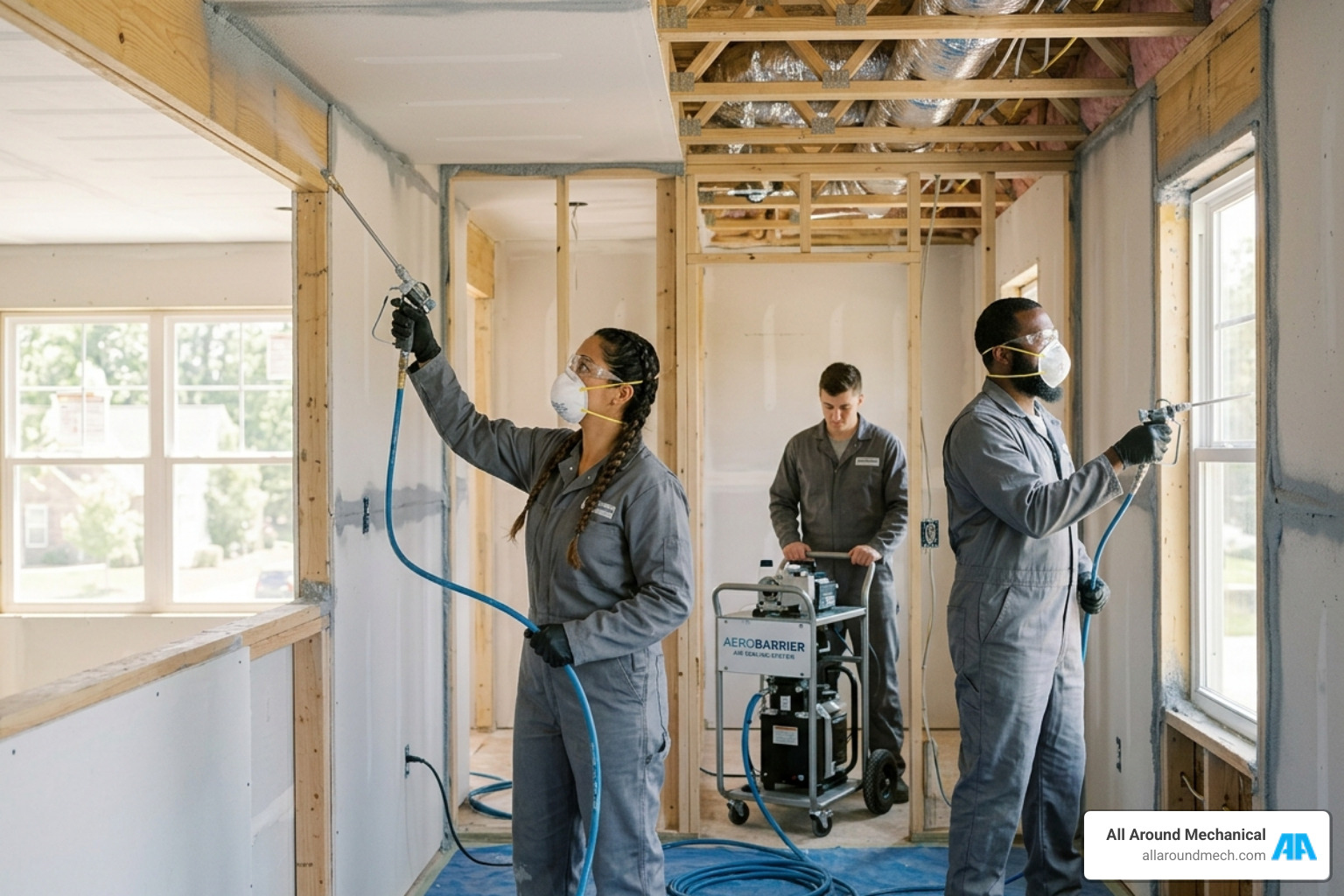
What the AeroBarrier Process Means for Vancouver, WA Homeowners
The aerobarrier process what homeowners should expect is straightforward: a certified technician sets up a blower door system, pressurizes your home to 100 pascals, releases a fine mist of water-based acrylic sealant into the air, and the sealant automatically seeks out and fills every gap and crack in your building envelope — all while a computer tracks your air tightness in real time, every 10 seconds, until your target is hit.
Here is a quick breakdown of what happens, start to finish:
- Setup — Equipment is brought in and a blower door is installed (typically at a doorway)
- Baseline test — The technician measures your home’s starting air leakage (ACH50)
- Surface protection — Horizontal surfaces, openings, and fixtures are covered or masked
- Pressurization — The home is brought to 100 pascals of positive pressure
- Sealing — Aerosolized sealant is released and self-guides to leaks from hair-thin gaps up to 1/2 inch wide
- Real-time monitoring — Leakage readings update every 10 seconds on a computer display
- Completion — Once your target ACH50 is reached, sealing stops automatically
- Ventilation — Doors and windows are opened for about 30 minutes to air out the space
- Cleanup and certification — Coverings are removed, surfaces are cleaned, and you receive a documented report of your results
For Southwest Washington homeowners in Vancouver, Ridgefield, Battle Ground, and surrounding areas, tighter homes mean real relief — lower energy bills, fewer drafts, and HVAC systems that don’t have to work as hard through the region’s wet, variable seasons. As of April 2026, energy codes are pushing new and renovated homes toward tighter performance standards, making air sealing more relevant than ever.
The entire process for a typical single-family home takes roughly four hours from setup to completion. Work on-site can resume just 30 minutes after the sealant is applied. The sealant itself is GREENGUARD Gold certified, non-toxic, and rated to last through a simulated 50-year durability test with little to no degradation.
Whether you are building new or tackling a major remodel, understanding each step helps you plan your project with confidence — and get the most out of the process.

Understanding the aerobarrier process what homeowners should expect
When we talk about the aerobarrier process what homeowners should expect, we are looking at a high-tech solution to an age-old problem: leaky houses. Traditional air sealing relies on manual labor—someone with a caulk gun crawling through an attic or basement trying to find every tiny hole. It is nearly impossible for a human to find every gap, especially those hidden behind cabinets or tucked under stairs.
AeroBarrier changes the game by using the air itself to find the leaks. We use a specialized emitter system placed strategically throughout your living areas. Once the house is pressurized to 100 pascals (roughly equivalent to a 20-mph wind hitting the house from all sides), the sealant mist is released. Because air is escaping through every crack, it carries the sealant particles directly to those gaps.
The sealant doesn’t just “fill” the hole; it accumulates across the edges of the leak, bonding to itself until the gap is completely closed. This automated precision allows us to seal holes as large as 1/2 inch and as tiny as a human hair. Throughout the process, we use a computer to track the ACH50 (Air Changes per Hour at 50 pascals). This real-time tracking ensures we hit your specific air-tightness goals—whether you are aiming for standard code compliance or the rigorous requirements of a Passive House. You can learn more about how we integrate this into your home by visiting our aerobarrier service page.
Preparing Your Home for the Sealing Day
Preparation is the most time-consuming part of the day, but it is also the most critical. To ensure the sealant only goes where it belongs, we have to “mask” the home.
If you are a homeowner in Vancouver or Camas getting ready for an AeroBarrier application, here is what we do to prepare the space:
- Masking Vertical Openings: Windows and exterior doors are closed and locked. Any designed openings that should be there, like fireplace flues or kitchen exhaust vents, are taped off with plastic.
- Protecting Horizontal Surfaces: While the sealant is designed to stay suspended in the air until it finds a leak, some may settle on horizontal surfaces. We cover finished flooring, countertops, and any built-in furniture with plastic or drop cloths.
- Electrical and Plumbing: We mask off electrical outlets and plumbing rough-ins. This prevents sealant from entering the internal components of your switches or clogging pipes.
- HVAC Isolation: Your heating and cooling system is precious. We completely isolate the HVAC unit and ductwork to ensure no sealant enters the mechanical system.
- Electronics and Valuables: In remodel scenarios, any remaining electronics or furniture must be thoroughly covered or moved out of the sealing zone.
By the time we are done prepping, your home will look a bit like a scene from a sci-fi movie, but this level of care ensures a clean result and a successful seal.
The Timeline: How Long Does the Application Take?
Efficiency is one of the biggest draws of this technology. For a typical single-family home in Southwest Washington, the entire appointment lasts about four hours.
The timeline generally breaks down like this:
- Setup and Prep: 1 to 2 hours.
- Sealing (Spraying): 60 to 90 minutes.
- Ventilation and Cleanup: 45 to 60 minutes.
The aerobarrier process what homeowners should expect during application
During the active sealing phase, you will see our technicians monitoring a laptop. This computer is the “brain” of the operation. It controls the emitters and receives data from the blower door every 10 seconds.
As the sealant fills the cracks, the “leakage” graph on the screen will begin to drop. It is incredibly satisfying to watch the numbers move toward the target. In Southwest Washington, where we deal with cold, damp winters, hitting a target like 1.5 ACH50 or lower can significantly change how your home feels and performs. The process is entirely computer-controlled, meaning there is no guesswork. We know exactly when the house has reached the desired level of tightness.
After the aerobarrier process what homeowners should expect for re-entry
Once the computer confirms we’ve hit the target, we shut down the emitters. However, you can’t walk back in immediately. We start a 30-minute ventilation period. We open the windows and doors and use fans to flush the remaining aerosol mist out of the house.
After those 30 minutes, the air is clear and the sealant is dry to the touch. You can safely enter without any protective gear. If you are in the middle of a construction project in Ridgefield or Battle Ground, your finish carpenters or painters can usually get back to work within an hour of us finishing. The environment is non-toxic and has no lasting odor. We perform a final walk-through to remove the masking and ensure the site is as clean as we found it.
Safety, Cleanup, and Post-Sealing Requirements
Safety is often the first thing homeowners ask about. The sealant used in the AeroBarrier process is a water-based acrylic. It is GREENGUARD Gold certified, which means it has been tested for low chemical emissions and is safe for use in sensitive environments like schools and healthcare facilities. It contains no harmful VOCs and does not off-gas after it dries.
In terms of durability, this isn’t a temporary fix. The sealant has been subjected to simulated 50-year durability tests and showed virtually no degradation. It stays flexible, allowing it to move with the home as it settles or expands and contracts with the changing Washington seasons.
| Feature | Manual Air Sealing | AeroBarrier Sealing |
|---|---|---|
| Precision | Human-dependent; often misses micro-gaps | Automated; seals gaps down to a hair-width |
| Verification | Requires a separate blower door test later | Real-time verification during the process |
| Time | Can take days of manual labor | Typically 4 hours total |
| Consistency | Highly variable | Guaranteed results every time |
| Reach | Limited to accessible areas | Reaches every hidden gap in the envelope |
Long-Term Benefits for Southwest Washington Homes
Why go through this process? In places like Vancouver and Washougal, the benefits are immediate and long-lasting.
- Energy Efficiency: When you stop air from leaking out, your heat pump or furnace doesn’t have to run as often. Homeowners typically see double-digit reductions in their heating and cooling energy use.
- Comfort: No more cold drafts near windows or outlets. Because the envelope is tight, the temperature stays uniform from room to room.
- Indoor Air Quality: A tight home keeps out pollutants like dust, pollen, and even wildfire smoke—a concern we know all too well in the Pacific Northwest.
- Humidity Control: By sealing out the damp exterior air, your indoor humidity levels stay more stable, reducing the risk of mold and moisture issues.
- HVAC Longevity: When your system cycles less frequently, there is less wear and tear on the components, potentially extending the life of your equipment.
Frequently Asked Questions about AeroBarrier
At what stage of construction should AeroBarrier be applied?
For new construction, the “sweet spot” is typically after drywall is hung, taped, and mudded, but before the final coats of paint and trim are installed. This allows the sealant to find all the gaps in the wall assemblies while making prep and cleanup much easier. It can also be done at the “rough-in” stage before insulation, depending on the specific goals of the builder.
Can AeroBarrier be used in existing homes or cold weather?
Yes! While it is most common in new construction, it can be used in existing homes that are undergoing a “gut” remodel. For occupied homes, the prep work is much more intensive because every piece of furniture and all finished surfaces must be protected. As for weather, the process can be performed in cold temperatures, though we use heaters to ensure the interior of the home stays at an optimal temperature for the sealant to bond correctly.
What documentation do I receive after the process?
One of the best parts of the aerobarrier process what homeowners should expect is the final report. You will receive a Certificate of Permeability that documents the starting ACH50 and the final ACH50. This is a vital piece of paperwork for building inspectors to prove code compliance, and it can even help with manufacturer warranties or energy efficiency rebates.
Conclusion
At All Around Mechanical, we believe that a comfortable home starts with a tight building envelope. By choosing AeroBarrier, you are investing in the long-term health, efficiency, and comfort of your house. Whether you are in Vancouver, Ridgefield, or anywhere else in Southwest Washington, our team of licensed HVAC professionals is here to guide you through the process.
We pride ourselves on providing exceptional service at competitive prices. If you are ready to eliminate drafts and lower your energy bills, we are ready to help. For more information or to discuss your specific project, visit our AeroBarrier service page and let’s get started on making your home the most comfortable it can be.