

 (360) 896-2829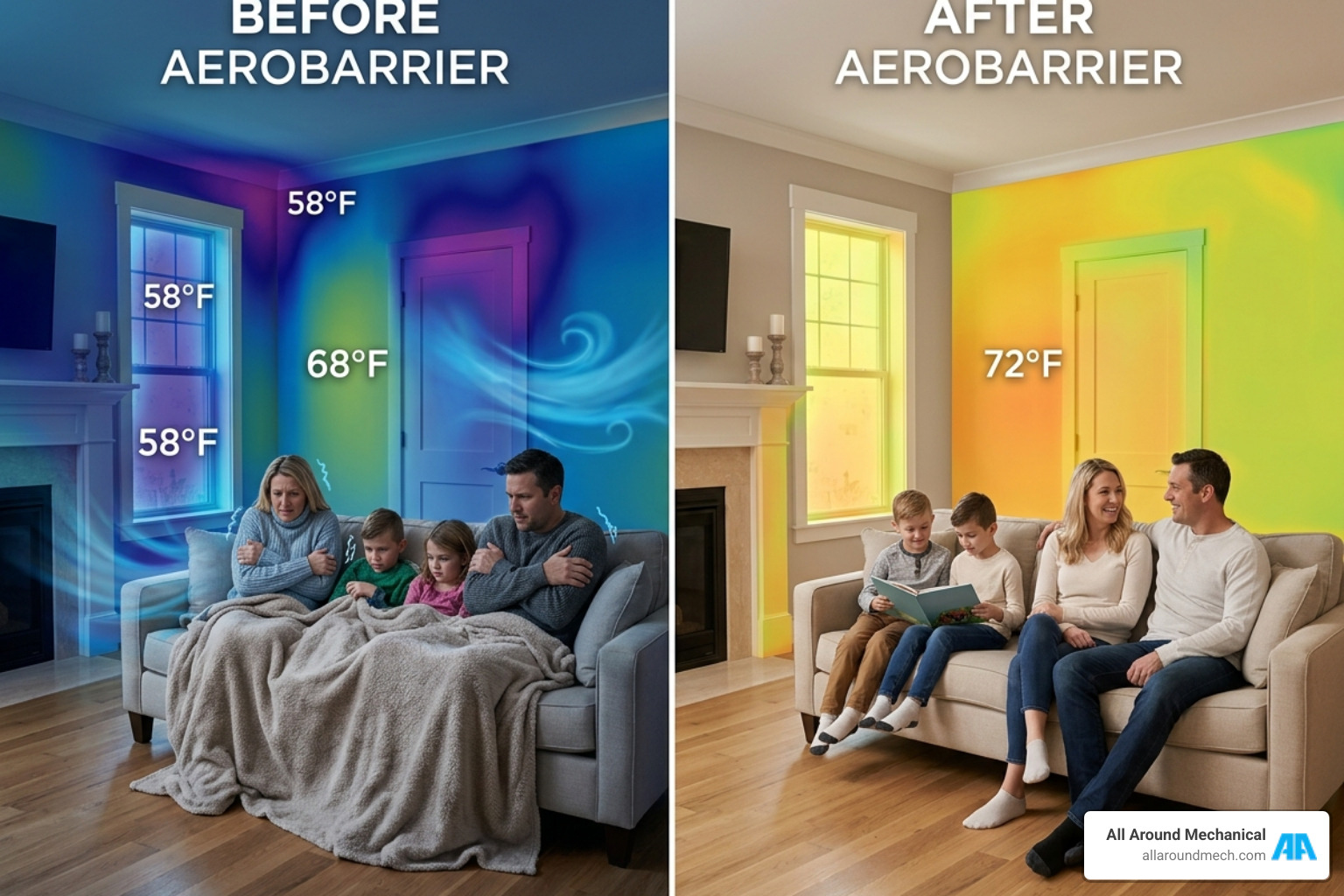
Understanding the Science of Drafts and Temperature Imbalances
To understand how AeroBarrier reduces drafts and hot cold spots, we first have to look at the physics of how air moves through a house. Most homeowners think of their walls as solid barriers, but in reality, a typical home has hundreds of tiny openings. These gaps are often hidden behind drywall, under floorboards, or inside “interstitial cavities”—the hollow spaces between your walls and floors.
One of the primary drivers of discomfort is the Stack Effect. In the winter, warm air rises and escapes through leaks at the top of the house (like recessed lights or attic hatches). This creates a vacuum that pulls cold outdoor air in through leaks at the bottom (like crawlspace vents or rim joists). This constant cycle creates that “drafty” feeling and forces your furnace to run non-stop.
Pressure imbalances also play a huge role. When your HVAC system blows air into a room, that room becomes pressurized. If the room has leaks, the conditioned air is pushed out into the wall cavities. This creates “convection loops,” where air swirls inside your walls, cooling down the surfaces you touch and making the room feel chilly even if the thermostat says it’s 72 degrees. By using aerobarrier, we can effectively “plug” these holes, stabilizing the pressure and keeping the air you paid to heat or cool exactly where it belongs.
How AeroBarrier Reduces Drafts and Hot Cold Spots
AeroBarrier represents a massive leap forward in building science. Instead of a technician crawling through an attic with a flashlight and a can of spray foam, AeroBarrier uses advanced aerosol technology to automate the process. We transform a specialized, water-borne acrylic sealant into a fine mist of microscopic particles.
Because we pressurize the house during the process, these particles are physically drawn toward any area where air is escaping. As the particles collide at the edge of a leak, they bond together, building a permanent, flexible seal. This technology targets the entire building envelope simultaneously, ensuring that every micro-gap is addressed.
The result is a home with uniform temperatures. When the building envelope is tight, air infiltration is minimized. This means you won’t have “wind” blowing through your electrical outlets or cold air pooling on your floors. More info about aerobarrier services can help you see how this technology fits into your specific home or project.
Eliminating the “Starved Room” Effect
Have you ever had a bedroom that feels “starved” for air? This often happens because of unbalanced airflow. If air is leaking out of the ductwork or the room’s envelope before it can circulate, the HVAC system can’t maintain the setpoint. AeroBarrier stabilizes room-to-room pressures, ensuring that conditioned air reaches every corner of the house. This eliminates those zones that always feel under-conditioned compared to the rest of the home.
Solving Temperature Stratification
Temperature stratification is that annoying phenomenon where your head feels warm but your feet are freezing. This is caused by exfiltration at the top of the home and infiltration at the bottom. In our Southwest Washington summers, hot, humid air sneaks in high while your expensive cooled air leaks out low. By sealing the envelope, AeroBarrier creates a “thermos effect,” providing uniform comfort and superior thermal control from floor to ceiling.
The Step-by-Step Process of Automated Air Sealing

At All Around Mechanical, we follow a precise, technology-driven process to ensure your home reaches its maximum potential for comfort and efficiency.
- Preparation: We protect the areas that shouldn’t be sealed.
- Pressurization: We use a blower door to create positive pressure.
- Application: The AeroBarrier stations release the atomized sealant.
- Real-Time Monitoring: We watch the leakage drop on a laptop screen.
- Certification: You receive a final report showing the exact ACH50 (Air Changes per Hour) achieved.
Preparing the Building for Application
Before we start the mist, we take care to protect your space. In a finished home or a renovation, we cover horizontal surfaces like floors and countertops. We also seal off sensitive equipment and any openings that are designed to stay open, like fireplace flues or permanent ventilation. This ensures the sealant only goes where it’s needed: inside the leaks.
How AeroBarrier reduces drafts and hot cold spots through real-time monitoring
The “magic” of this system is the software integration. Traditional sealing is a guessing game—you seal a hole and hope it made a difference. With aerobarrier, we set a target ACH50 level (the industry standard for measuring airtightness). As the mist fills the air, the blower door system measures the leakage every few seconds. We can actually see the “leaky” square inches disappearing in real time. This targeted sealing continues until your home meets the high-performance standards we’ve set.
Final Verification and Certification
Once the target is reached, the system is turned off, and the sealant dries quickly. We then run a final blower door test to provide a verifiable report. This isn’t just a “trust us, it’s better” service; you get a data-backed certificate of your home’s new airtightness. This is especially helpful for builders in Ridgefield or Vancouver who need to meet strict Washington state energy codes.
Why AeroBarrier Outperforms Traditional Sealing Methods
Manual sealing is prone to human error. It is nearly impossible for a person to find every tiny gap around a top plate or a plumbing penetration hidden behind a bathtub.
| Feature | Traditional Manual Sealing | AeroBarrier Sealing |
|---|---|---|
| Precision | Relies on visual inspection | Guided by air pressure to find hidden leaks |
| Reliability | Often misses microscopic gaps | Seals holes as small as a human hair |
| Verification | Requires a separate post-test | Real-time measurement during application |
| Speed | Can take days to do thoroughly | Usually completed in 60-90 minutes |
| Coverage | Spot treatment only | Whole-home envelope coverage |
Reaching the Unreachable
Traditional methods struggle with “micro-leaks.” These are the gaps around electrical switches, where the drywall meets the top plates, and the tiny cracks around rim joists. AeroBarrier’s mist is drawn into these spaces by the pressure, sealing areas that are physically impossible to reach with a caulk gun.
How AeroBarrier reduces drafts and hot cold spots in new construction and retrofits
Whether you are building a new “forever home” in Camas or gut-renovating a classic 1970s house in Longview, AeroBarrier is versatile. The ideal time for application is usually post-drywall, but it can be adapted for various stages of construction. In our Southwest Washington climate, where we deal with both damp winters and surprisingly hot summers, a tight envelope is the best defense against the elements.
Beyond Comfort: The Additional Benefits of a Sealed Envelope
While the primary goal is often to fix those “icy tundras” in the back bedrooms, the benefits of using aerobarrier extend much further.
Improving Indoor Air Quality and Health
A leaky home doesn’t just let air out; it lets “bad stuff” in. This includes dust, outdoor allergens, and pollutants from your crawlspace or garage. By creating a tight seal, you gain total control over your indoor air quality. Because the sealant is Greenguard Gold certified, it is safe for use in homes, schools, and even healthcare facilities, with no off-gassing concerns.
Protecting the Structure from Moisture and Pests
In the Pacific Northwest, moisture is our biggest enemy. Air leaks carry up to 90 times more moisture into your wall cavities than vapor diffusion through drywall. This moisture can lead to condensation, which eventually causes mold and structural rot. Furthermore, an airtight home is a pest-resistant home. If air can’t get through a gap, it’s much harder for spiders and insects to find their way in.
Frequently Asked Questions about AeroBarrier
Is the AeroBarrier sealant safe for my family?
Yes! The sealant is a water-borne acrylic that is ultra-low VOC and Greenguard Gold certified. It contains no harmful chemicals and doesn’t off-gas. Once the application is finished and we’ve aired out the house for about 30 minutes, it is perfectly safe to enter.
How long does the sealing process take to complete?
The actual sealing time is remarkably fast, usually taking between 60 and 90 minutes. When you include setup and cleanup, we are typically in and out in a single day. This is a fraction of the time it would take to manually seal a home to the same standard.
When is the ideal time to schedule air sealing during a build?
For new construction, the “sweet spot” is right after drywall has been hung and finished, but before the final trim and paint. This allows the sealant to hit all the primary leak points in the building envelope without requiring extensive protection for finished surfaces.
Conclusion
At All Around Mechanical, we believe everyone in Southwest Washington deserves a home that is consistently comfortable, healthy, and efficient. We’ve seen how AeroBarrier reduces drafts and hot cold spots, transforming homes from drafty and expensive to cozy and cost-effective.
Whether you are in Vancouver, Battle Ground, or Washougal, our team is ready to help you achieve a high-performance home envelope. Don’t settle for a house with “moody” temperatures. Say goodbye to drafts with AeroBarrier and experience the difference that modern building science can make. Give us a call today to see how we can bring total comfort to your living space.