

 (360) 896-2829
How Federal Tax Credits for Heat Pump and Envelope Upgrades Can Save You Thousands
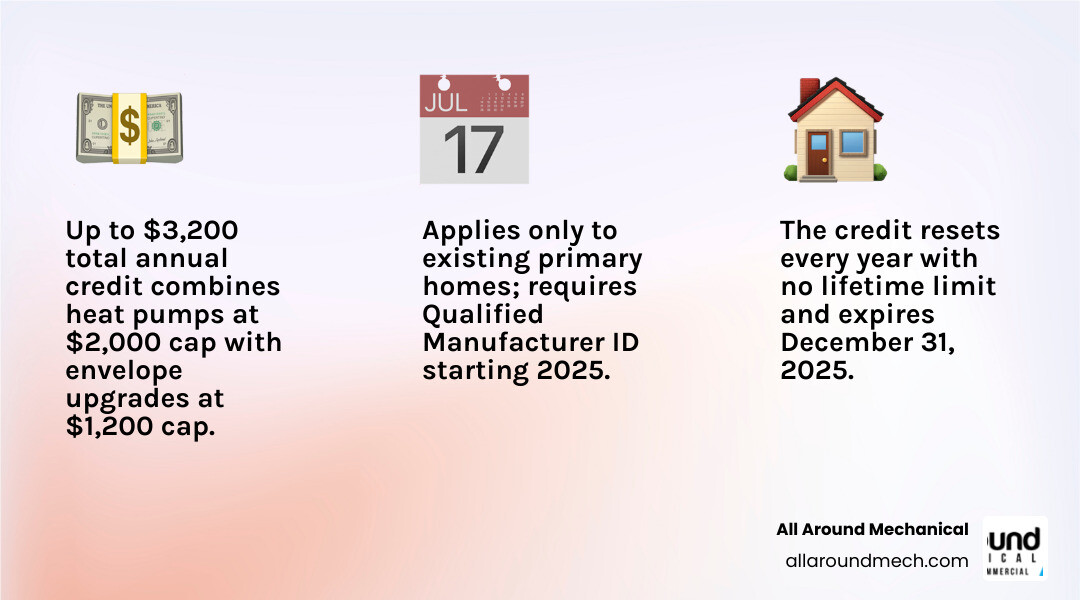
Federal tax credits for heat pump and envelope upgrades are one of the most valuable — and underused — ways homeowners in Vancouver, WA and across Southwest Washington can cut the cost of going energy efficient. Under Section 25C of the tax code, as expanded by the Inflation Reduction Act, eligible homeowners can claim up to $3,200 per year in nonrefundable federal tax credits for qualifying improvements installed through December 31, 2025.
Here’s a quick summary of what’s available:
| Improvement Type | Credit Rate | Annual Cap |
|---|---|---|
| Heat pumps (air source) | 30% of cost | $2,000 |
| Heat pump water heaters | 30% of cost | $2,000 (combined with heat pumps) |
| Insulation and air sealing | 30% of materials only | $1,200 |
| Exterior windows and skylights | 30% of cost | $600 |
| Exterior doors | 30% of cost | $250/door, $500 total |
| Home energy audits | 30% of cost | $150 |
| Maximum combined annual credit | $3,200 |
A few important things to know upfront:
- The credit is nonrefundable — it can reduce your tax bill to zero, but you won’t receive any excess as a refund, and unused amounts cannot be carried forward.
- There is no lifetime cap, meaning you can claim up to the annual maximum every eligible year.
- Credits apply to existing homes only — not new construction.
- Starting in 2025, most qualifying equipment requires a Qualified Manufacturer Identification Number (QMID) reported on your tax return.
- The credit is set to expire December 31, 2025, so time matters.
Whether you’re planning a full heat pump installation or just adding insulation this year, understanding how these credits work — and how to stack them smartly — can make a real difference in what you pay out of pocket.
Understanding the Federal Tax Credits for Heat Pump and Envelope Upgrades
Navigating federal tax incentives can sometimes feel like trying to program a complex thermostat in the dark. However, the Energy Efficient Home Improvement Credit (Section 25C) is designed to be highly rewarding for homeowners who take the time to understand its structure.
The baseline rule is straightforward: you can claim a tax credit equal to 30% of the qualified expenses for eligible upgrades. Unlike older versions of this credit, which had a lifetime limit of $500, the current version resets annually. This annual reset completely transformed the landscape for home energy planning, allowing you to space out projects over multiple tax years to maximize your savings.
It is crucial to remember that Section 25C is a nonrefundable tax credit. This means it can reduce your federal tax liability down to zero, but the IRS will not write you a check for any remaining credit amount if your tax liability is lower than the credit you earned. Furthermore, any unused credit cannot be carried forward to future tax years. Planning your installations around your projected tax liability for the year is the best way to ensure you receive the full financial benefit.

Annual Limits and Qualifying Standards for Federal Tax Credits for Heat Pump and Envelope Upgrades
While the total possible tax credit in a single year is capped at $3,200, this limit is split into two distinct “buckets.” Understanding these sub-limits is the key to maximizing your financial return:
- The Heat Pump and Biomass Bucket (Capped at $2,000): This category includes electric or natural gas air-source heat pumps and heat pump water heaters. You can claim up to 30% of the purchase and installation costs, up to a maximum of $2,000 per year.
- The Building Envelope Bucket (Capped at $1,200): This category covers insulation, air sealing, windows, skylights, and exterior doors.
To help you visualize how these caps apply to specific purchases, here is a detailed breakdown of the qualifying standards and limits:
| Upgrade Category | Specific Sub-Limit | Minimum Efficiency Standard Required |
|---|---|---|
| Air Source Heat Pump | $2,000 | Must meet Consortium for Energy Efficiency (CEE) highest tier (typically SEER2 $\ge$ 16, EER2 $\ge$ 12, HSPF2 $\ge$ 9) |
| Heat Pump Water Heater | $2,000 | Must meet the highest CEE efficiency tier |
| Insulation & Air Sealing | $1,200 | Must meet the prescriptive criteria of the 2021 International Energy Conservation Code (IECC) |
| Exterior Windows & Skylights | $600 | Must meet ENERGY STAR Most Efficient criteria |
| Exterior Doors | $250 per door ($500 total) | Must meet ENERGY STAR requirements |
| Home Energy Audit | $150 | Must include auditor’s EIN, certification attestation, and meet IRS Notice 2023-59 |
When evaluating these limits, installing both an air-source heat pump and a heat pump water heater in the same tax year will still subject you to the single $2,000 category limit. If you want to dive deeper into why transitioning to this technology is beneficial beyond the tax codes, check out our guide on Why Upgrading Heat Pump is Ideal.
Eligible Building Envelope Upgrades and Efficiency Standards
Your heating and cooling systems only work as well as the structure containing them. If your home is drafty or poorly insulated, your brand-new heat pump will have to work twice as hard to maintain comfortable temperatures. That is why the federal government incentivizes building envelope upgrades alongside mechanical systems.
To qualify for the 30% credit under the $1,200 envelope limit, your materials must meet strict prescriptive guidelines:
- Insulation and Air Sealing: Materials and systems (such as blown-in fiberglass, spray foam, or advanced sealing systems) must satisfy the prescriptive criteria of the 2021 International Energy Conservation Code (IECC) that was in effect two years prior to the installation year. Fortunately, no third-party air leakage testing is required to claim the tax credit—you simply need to ensure the materials used meet these standards.
- Exterior Windows and Skylights: These are capped at a combined total of $600 and must meet the rigorous “ENERGY STAR Most Efficient” standards.
- Exterior Doors: You can claim up to $250 per door, with a total cap of $500, provided they are ENERGY STAR certified.
By sealing up your home’s envelope first, you reduce the overall heating and cooling load. This often allows you to install a smaller, more affordable heat pump system. To learn more about how a tighter home envelope directly impacts your comfort and utility bills, read about How a Tighter Building Envelope Saves You Money and Energy and explore our specialized AeroBarrier ROI and Comfort Guide for Homeowners.
Manufacturer Requirements and Claiming Federal Tax Credits for Heat Pump and Envelope Upgrades
As we navigate the 2025 and 2026 tax landscape, the IRS has introduced stricter documentation rules to prevent fraudulent claims. For any qualified energy property placed in service, the equipment must be produced by a “Qualified Manufacturer.”
When you file your taxes, you are required to provide the Qualified Manufacturer Identification Number (QMID) or a specific manufacturer product PIN on your tax return. This rule applies to heat pumps, heat pump water heaters, central air conditioners, furnaces, boilers, and windows.
Note: Insulation and air sealing materials are currently the only major category exempt from the QMID and PIN reporting requirements.
To ensure a seamless filing process, we recommend creating a dedicated “Green Folder” immediately after your installation. This folder should contain:
- The detailed invoice showing separate costs for equipment and labor.
- The Manufacturer Certification Statement, which explicitly states that the specific model number qualifies for the Section 25C tax credit.
- The QMID or product PIN provided by the manufacturer.
- For home energy audits, a copy of the written audit report containing the auditor’s name, taxpayer identification number (EIN), and professional certification details.
Keeping these records organized is vital for protecting your claim in the event of an IRS audit. For more information on how these energy-efficient investments translate into long-term equity, check out our Detailed Guide to Energy Efficient HVAC and Home Value.
Maximizing Your Savings: Stacking Credits and Rebates
One of the most common mistakes homeowners make is thinking they have to choose between a manufacturer rebate, a utility incentive, and a federal tax credit. In reality, you can often “stack” these financial incentives to dramatically lower the net cost of your home comfort upgrades.
However, stacking requires careful planning and a clear understanding of how different programs interact. While some rebates directly reduce the cost basis used to calculate your tax credit, others do not. Let’s look at how to strategically map out your upgrades.
Multi-Year Upgrade Strategies
Because the Section 25C tax credit resets every year, you can maximize your total savings by staggering your projects across multiple tax years.
For example, if you need a new heat pump, a new heat pump water heater, attic insulation, and an electrical panel upgrade to support the new equipment, doing everything in a single calendar year would cause you to blow past the annual caps:
- Single-Year Approach: If you install everything at once, your total tax credit is strictly capped at $3,200 (combining the $2,000 heat pump limit and the $1,200 envelope/panel limit).
- Multi-Year Approach:
- Year 1: Install your qualifying air-source heat pump and perform a home energy audit. You claim a $2,000 credit for the heat pump and a $150 credit for the audit.
- Year 2: Upgrade your electrical panel (eligible for up to a $600 credit when installed to support qualifying energy-efficient equipment) and add attic insulation (claiming up to the $1,200 envelope cap).
- Year 3: Install your heat pump water heater, claiming another $2,000 credit.
By spreading these projects out, you can legally claim thousands of dollars more in total tax credits. To see how these upgrades keep paying dividends long after tax season, read our article on Why Upgrading Your Air is a Breath of Fresh Air for Your Home Value.
How Rebates and Subsidies Impact Your Tax Credit
When calculating your 30% federal tax credit, you must subtract certain rebates and subsidies from the total project cost to determine your “qualified expenses.”
The IRS distinguishes between different types of financial incentives:
- Utility Rebates & Point-of-Sale Subsidies: If you receive an instant utility rebate or a state subsidy under the High-Efficiency Electric Home Rebate Program (HEEHR) that reduces the purchase price at the register, you must subtract this amount before calculating your tax credit. For example, if a qualifying heat pump system costs $10,000 and you receive a $2,000 point-of-sale utility rebate, your qualified expense is $8,000. Your 30% tax credit is calculated from the $8,000 balance, yielding a $2,400 credit (which is then capped at the category limit of $2,000).
- State HOMES Rebates: Because the HOMES rebate program is technology-neutral and based on measured whole-house energy savings rather than individual equipment purchases, these rebates generally do not reduce the cost basis of your specific HVAC equipment for tax purposes.
To make sure you are capturing every local dollar available in Southwest Washington, consult The Evergreen State Guide to High Efficiency Heating and Sealing Rebates and use our helpful tool for Calculating the ROI of Your Next HVAC Upgrade.
Key Differences: Energy Efficient Home Improvement Credit vs. Residential Clean Energy Credit
It is easy to confuse the Energy Efficient Home Improvement Credit (Section 25C) with the Residential Clean Energy Credit (Section 25D). However, they govern entirely different types of technology and have completely different tax rules:
| Feature | Section 25C (Home Improvement) | Section 25D (Clean Energy) |
|---|---|---|
| Primary Technologies | Heat pumps, heat pump water heaters, insulation, windows, doors, central AC, furnaces | Solar panels, solar water heaters, wind turbines, geothermal heat pumps, battery storage |
| Credit Rate | 30% of qualified expenses | 30% of qualified expenses |
| Annual Credit Limits | Strictly capped ($1,200 / $2,000 / $3,200 max) | No dollar limit |
| Carryforward Rules | Nonrefundable; cannot be carried forward | Nonrefundable; can be carried forward to future years |
| Labor Costs | Eligible for HVAC/heat pumps; not eligible for insulation/envelope materials | Fully eligible for all qualifying installations |
If you are installing a standard air-source heat pump, you will file under Section 25C. If you are installing an underground geothermal heat pump, you will file under Section 25D—meaning you can deduct a full 30% of the entire project cost with no upward limit, and carry any unused credit over to the next tax year.
Regardless of which system you choose, keeping your equipment running at peak efficiency is the best way to protect your investment. Learn more by reading The Real ROI of Regular Heating and Cooling Tune-Ups.
Frequently Asked Questions About Home Energy Tax Credits
Can I claim the credit for a second home, rental property, or as a renter?
The rules vary depending on the type of upgrade you are making:
- Primary Residences: All qualifying upgrades (envelope and heating/cooling) are eligible.
- Second Homes / Vacation Homes: You cannot claim the credit for building envelope components (insulation, windows, doors) on a second home. However, you can claim the credit for residential energy property, such as air-source heat pumps and heat pump water heaters, provided you reside in the home for part of the year and do not rent it out.
- Rental Properties: Landlords cannot claim the Section 25C credit for properties they do not live in.
- Renters: If you are a tenant and pay for a qualifying upgrade (such as an energy audit or a portable heat pump system) with your landlord’s permission, you can claim the credit on your personal tax return.
Are labor and installation costs eligible for the tax credit?
It depends on the category:
- Residential Energy Property (Heat Pumps, Water Heaters, Central AC): Yes, labor and installation costs are fully eligible and should be included in your 30% calculation.
- Building Envelope Components (Insulation, Windows, Doors): No. For envelope upgrades, only the cost of the actual materials qualifies for the tax credit. Your installation contractor must provide an invoice that clearly separates the material costs from the labor charges.
What tax form is required to claim these credits?
To claim both the Section 25C and Section 25D credits, you must complete and file IRS Form 5695 (Residential Energy Credits) along with your standard Form 1040 federal tax return. You will use Part II of Form 5695 to calculate and report your energy-efficient home improvements, including entering the necessary QMID or product PINs for eligible equipment. We always recommend consulting with a certified tax professional to review your documentation before filing.
Conclusion
Upgrading your home’s heating, cooling, and insulation is one of the smartest decisions you can make for your year-round comfort and your wallet. With federal tax credits covering up to 30% of your project costs, there has never been a better time to invest in high-efficiency systems.
At All Around Mechanical, we are proud to be the trusted, licensed HVAC experts serving homeowners in Ridgefield, Vancouver, Brush Prairie, Battle Ground, Camas, Washougal, Yacolt, Ariel, La Center, Amboy, Kalama, and Longview, WA. We specialize in designing and installing qualifying heat pump systems that maximize both your home comfort and your tax savings.
Ready to take control of your energy bills and lock in your federal tax savings before the deadline? Claim your savings with All Around Mechanical’s HVAC promotions or contact our friendly team today to schedule your personalized home comfort consultation!