

 (360) 896-2829
Why Your Summer AC Bill Is So High (And What You Can Do About It)
How to lower ac bills during summer is one of the most common questions homeowners in Vancouver, WA ask when the season’s first electric bill arrives and the number is shocking. You’re not alone. Cooling costs make up as much as 50% of a home’s summer power bill, and the average American household spends around $422 on electricity between June and August alone.
Here in Southwest Washington, summers are getting hotter and longer. That means your AC is working harder — and your wallet is feeling it.
The good news? You don’t need to replace your whole system to see real savings. Small, smart changes can add up fast:
Quick ways to lower your AC bill this summer:
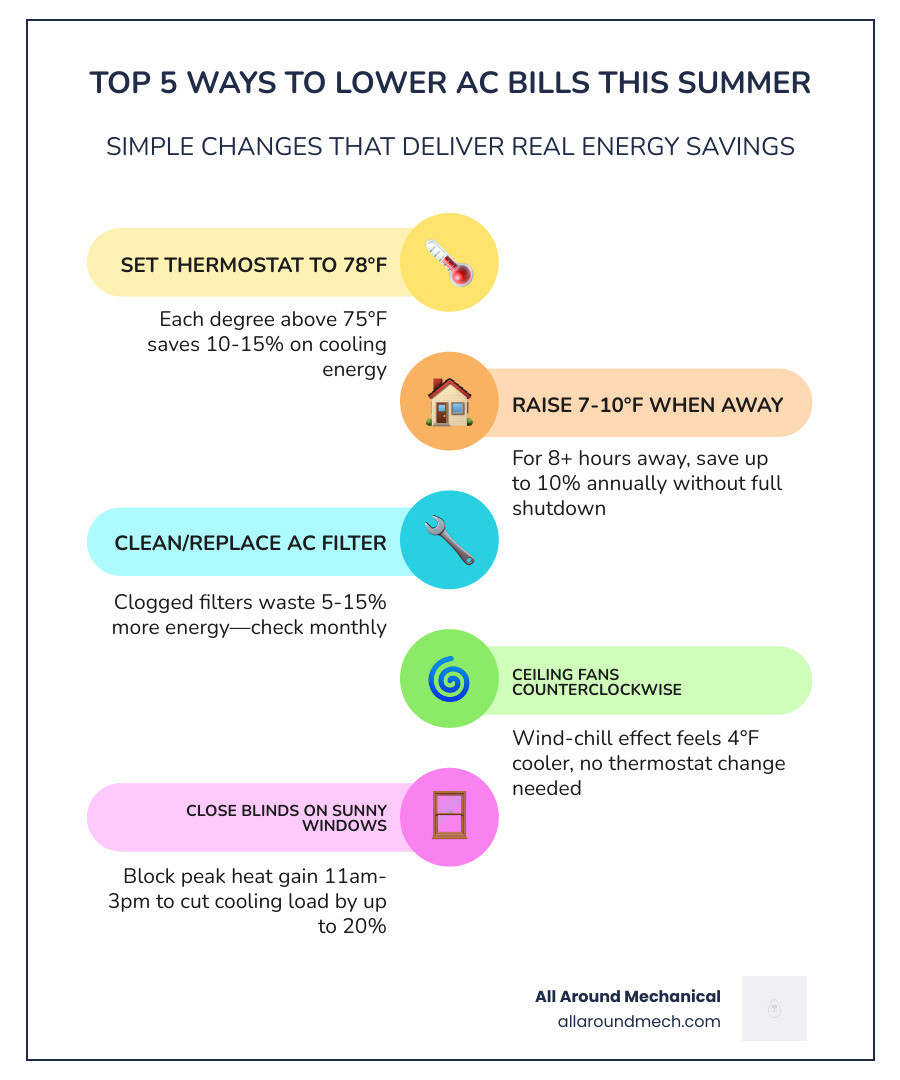
- Set your thermostat to 78°F when you’re home — each degree above 75°F can save 10-15% on energy use
- Raise the thermostat 7-10°F when you leave for 8+ hours — this alone can save up to 10% annually
- Replace or clean your AC filter — a clogged filter wastes 5-15% more energy
- Run ceiling fans counterclockwise — creates a wind-chill effect so you feel 4°F cooler without touching the thermostat
- Close blinds on sunny windows — especially between 11am and 3pm when heat gain peaks
- Seal air leaks around windows and doors — leaks can increase cooling costs by up to 20%
- Schedule a professional AC tune-up — a well-maintained system runs far more efficiently
This guide walks through every one of these strategies in detail, with the numbers to back them up.
Smart Strategies on How to Lower AC Bills During Summer
When it comes to your cooling budget, your thermostat is the most powerful tool in your house. Many of us in Ridgefield and Battle Ground grew up thinking that 68°F or 70°F was the “correct” summer temperature, but those settings force your air conditioner to run almost constantly during a Washington heatwave.
The U.S. Department of Energy recommends setting your thermostat to 78°F when you are at home. We know that might sound a bit warm at first, but your body can actually acclimate to higher indoor temperatures quite quickly. For every degree you set your thermostat above 75°F, you could save between 10% and 15% on the energy used by your cooling system.
If 78°F feels like a stretch, try moving the dial up just one degree every few days. You’ll likely find that with a light breeze from a fan, 76°F or 77°F feels perfectly comfortable while significantly padding your bank account. To dive deeper into these adjustments, check out our 5 smart tips to improve AC efficiency.
| Thermostat Setting | Potential Energy Savings |
|---|---|
| 75°F | Baseline |
| 78°F | 30% – 45% Savings |
| 80°F | 50% – 60% Savings |
| 85°F (When Away) | Maximize Efficiency |
How to lower ac bills during summer with smart thermostats
One of the best ways to ensure you never forget to adjust your settings is to install a smart thermostat. These devices do more than just let you change the temperature from your phone while you’re at the Salmon Creek farmers market. They learn your schedule and automatically adjust the air conditioning to save energy when the house is empty.
Smart thermostats provide detailed energy usage reports, helping you see exactly when your system is working hardest. If you find your unit is running non-stop just to maintain a standard temperature, you might wonder, is your current AC energy inefficient? A smart thermostat can help you diagnose these patterns before they lead to a total system failure.
Optimal settings when you are away from home
A common myth is that it’s cheaper to leave the AC running at one temperature all day than to let the house warm up and “work harder” to cool it down later. This isn’t true. For maximum savings, you should raise your thermostat by 7 to 10 degrees for at least 8 hours a day.
If you prefer a cool 72°F when you’re sleeping, try setting it to 80°F or 82°F while you’re at work in Vancouver or Camas. This simple 8-hour adjustment can save you as much as 10% a year on cooling. For more guidance on protecting your unit during these transitions, see our 8 tips for taking care of your AC during summer.
Optimize Airflow and System Maintenance
Airflow is the lifeblood of your HVAC system. When air can’t move freely, your AC has to work twice as hard to move half as much cool air. The simplest maintenance task—changing your air filter—is also one of the most effective. Clearing a clogged filter alone can save 5% to 15% in energy use.
In Southwest Washington, we deal with significant pollen in the spring and dust in the summer. We recommend checking your filter every 30 days during peak season. For a complete DIY checklist, read our 10 simple air conditioner maintenance tips you need to know.
How to lower ac bills during summer using ceiling fans
Ceiling fans don’t actually lower the temperature of a room; they cool people through the wind-chill effect. By moving air across your skin, a fan helps evaporate moisture more quickly, making you feel up to 4 degrees cooler.
The key is the direction: in the summer, your fan blades should rotate counterclockwise. This pushes a column of air directly down. Because you feel cooler, you can raise your thermostat by about 4 degrees without losing any comfort. Since fans use roughly 1/60th the energy of an air conditioner, this is a massive win for your utility bill. Just remember: fans cool people, not rooms. Turn them off when you leave! Learn more about the best way to keep your house cool in the summer.
Professional tune-ups for peak performance
While DIY maintenance is great, some things require a professional touch. A technician can clean the evaporator and condenser coils, check refrigerant levels, and ensure all electrical connections are tight.
Dirty coils can force your system to run 20% longer to achieve the same cooling effect. By scheduling a spring tune-up, you reduce mechanical strain and prevent the “emergency” repairs that always seem to happen on the hottest day of the year in Washougal. Discover 8 ways professional AC maintenance keeps the repairman away.
Seal Your Home Envelope and Block Solar Heat
Your home is like a giant cooler. If you leave the lid cracked or the sides are thin, the ice melts. In your home, the “ice” is the cool air you’ve already paid for. Up to 50% of your home’s summer power bill comes from cooling, and much of that can be lost through poor insulation or air leaks.
Window treatments are your first line of defense against the sun. Closing blinds, shades, or drapes on the south and west-facing sides of your home can block a massive amount of solar heat gain. Smart blinds that close automatically during peak heat hours (usually 11 am to 3 pm) can be even more effective. For more home cooling hacks, check out our 20 air conditioner maintenance and home cooling tips.
Landscaping for natural cooling
Nature provides some of the best energy-saving tools available. Planting deciduous trees or tall shrubs on the south and west sides of your house can make your cooling system up to 10% more efficient.
Trees provide shade during the summer but lose their leaves in the winter, allowing the sun to help heat your home when it’s cold. Even shading your outdoor AC unit with a trellis or shrubs (while maintaining at least 2 feet of clearance for airflow) can improve efficiency. See our guide on how to protect your AC in the summer for more landscaping advice.
Preventing air leaks in SW Washington homes
Air leaks are the “silent killers” of energy efficiency. Small cracks around window frames, gaps under doors, and leaky ductwork can allow your expensive cool air to escape into the attic or outside.
Sealing these leaks with caulk and weatherstripping can save up to 20% on annual heating and cooling costs. Don’t forget the attic; 90% of American homes are under-insulated. Adding a fresh layer of insulation can keep the heat from the roof from radiating down into your living space. For more on keeping your system healthy, read about 7 preventive maintenance tips to keep your AC healthy.
Adjust Daily Habits to Reduce Internal Heat
Sometimes the heat is coming from inside the house. Large appliances like ovens, clothes dryers, and dishwashers generate a lot of heat and humidity. Using them during the hottest part of the day forces your AC to work overtime to cancel out the heat you just created.
Try to shift your appliance use to off-peak hours, such as early morning or late evening. Better yet, use an outdoor grill or a microwave, which uses much less energy and doesn’t heat up the kitchen. We also recommend checking out these 10 summer air conditioning maintenance tips for more habit-based savings.
Cooking and lighting adjustments
Lighting is another heat source. If you’re still using old incandescent bulbs, only 10% of the energy they use goes to light—the other 90% is released as heat. Switching to LED bulbs is an easy way to lower the temperature in your rooms.
When it comes to meals, “no-cook” nights or using the microwave can keep your kitchen several degrees cooler. These small shifts in how you manage your home can make a big difference in how to lower ac bills during summer. For more preparation tips, see how to maintain your air conditioner to be ready for the summer.
Managing humidity for better comfort
In Vancouver and the surrounding SW Washington area, humidity can make 75°F feel like 80°F. Your AC acts as a dehumidifier, but it has to work much harder when moisture levels are high.
Use exhaust fans in bathrooms and kitchens to vent steam directly outside. Also, ensure your water heater is set to no more than 120°F. Water heating accounts for about 18% of home energy use, and a lower setting reduces the ambient heat in your utility room. Understanding the benefits of preventative AC maintenance can help you keep your system’s dehumidification features working perfectly.
Frequently Asked Questions About Lowering AC Costs
Is it cheaper to leave the AC on all day or turn it off?
It is generally cheaper to use a “setback” strategy. Turning the AC off completely can lead to high humidity levels and a “heat soak” effect where your furniture and walls get so hot that the system has to run for hours just to catch up. Instead, raise the temperature by 7-10 degrees when you’re away. This maintains some humidity control while saving significant energy. Learn more about regular AC maintenance benefits.
What are the signs my AC needs professional service?
If you notice weak airflow, strange banging or squealing noises, or if the unit is “short cycling” (turning on and off every few minutes), it’s time to call the pros. Frequent cycling is often a sign that the unit is struggling to meet the thermostat’s demands, which will send your bill through the roof. Explore the 5 benefits of professional air conditioning maintenance to see why proactive care matters.
How often should I change my filter in Vancouver, WA?
We recommend every 30 to 90 days. If you have pets, allergies, or live near a dusty area like a construction site or a dirt road in Yacolt, you should lean toward every 30 days. A clean filter ensures maximum airflow and keeps your indoor air quality high. If you’re unsure if your current unit is the right fit for your home’s needs, you can learn how to calculate air conditioner size for your house.
Conclusion
Lowering your summer cooling costs doesn’t have to mean suffering in a sweltering house. By combining smart thermostat habits, simple DIY maintenance like filter changes, and blocking out the sun with window treatments, you can keep your home comfortable without breaking the bank.
At All Around Mechanical, we’ve spent years helping our neighbors in Vancouver, Ridgefield, Battle Ground, and throughout Southwest Washington stay cool for less. Whether you need a quick tune-up to boost efficiency or a complete system upgrade to a high-efficiency heat pump, our licensed professionals are here to provide exceptional service at competitive prices.
Don’t wait for the next record-breaking heatwave to find out your AC isn’t running at its best. Schedule your professional air conditioning service in Brush Prairie today and start saving on your summer utility bills!