

 (360) 896-2829
When to Stop Repairing and Start Replacing Your HVAC System
The signs your HVAC needs replacing, not just fixing, are often easier to spot than most homeowners expect — once you know what to look for.
Here is a quick summary of the most reliable replacement indicators:
- System age — Air conditioners and heat pumps over 10–15 years old; furnaces over 15–20 years old
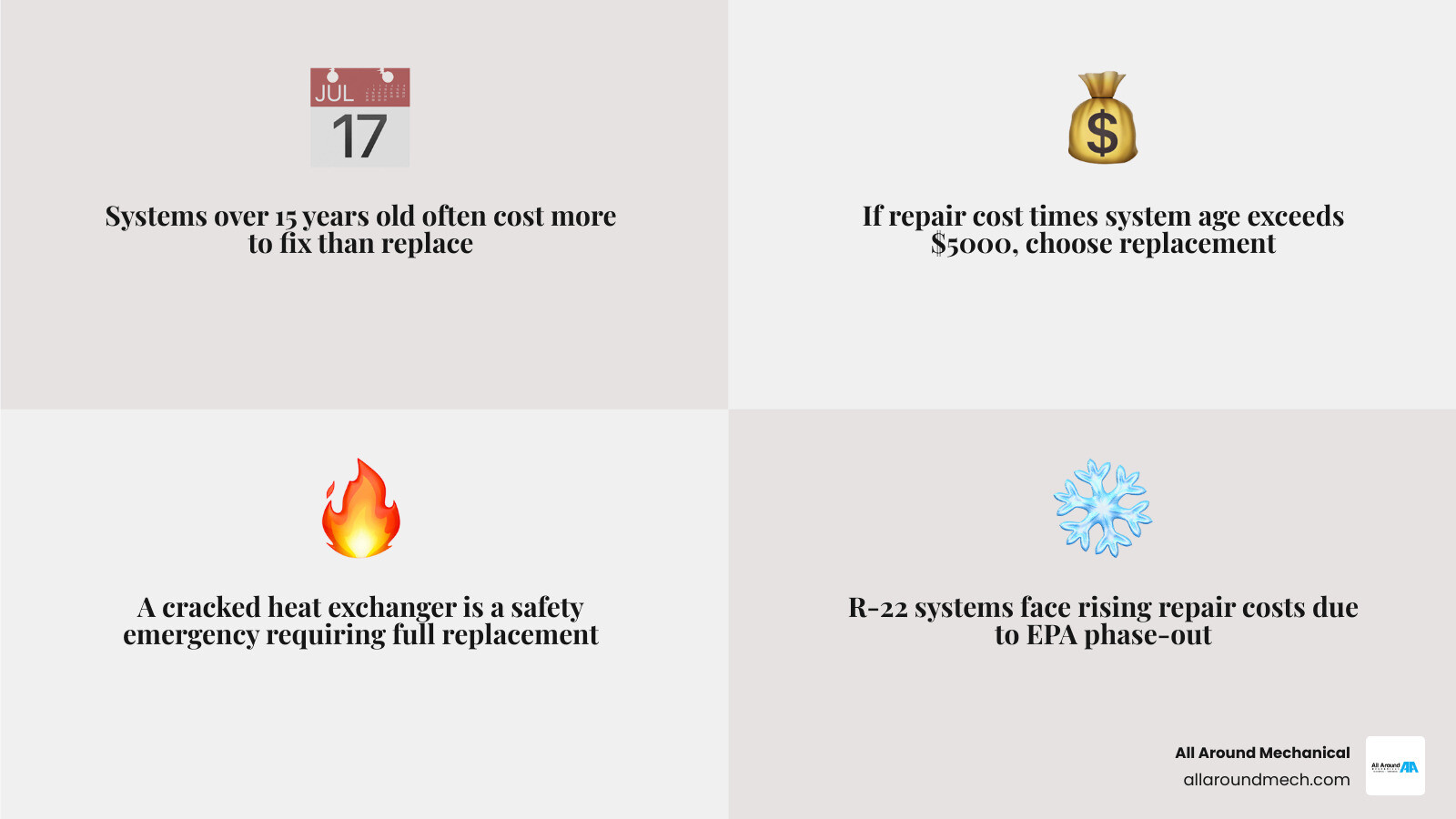
- The $5,000 Rule — Multiply your system’s age by the repair quote; if the result exceeds $5,000, replacement usually wins
- The 50% Rule — If repair costs exceed 50% of what a new system would cost, replace it
- Frequent breakdowns — Three or more repairs within three years is a strong signal
- Rising energy bills — Steady increases without a clear cause point to efficiency decline
- R-22 refrigerant — If your system runs on R-22, repairs are now extremely costly due to the EPA phase-out
- Cracked heat exchanger — This is a safety emergency; replacement is the only safe option
- Uneven temperatures or poor humidity control — Signs the system can no longer do its job
- Strange noises or odors — Especially burning smells or banging sounds on older units
Most homeowners in Vancouver, WA and throughout Southwest Washington don’t think about their HVAC system until it fails on the hottest afternoon in August or the coldest morning in January. That reactive approach almost always costs more — both in emergency service fees and in the stress of making a big financial decision under pressure.
The good news is that the warning signs are usually there long before a total breakdown. Whether your system is limping along with repeated repairs or you just received a repair quote that made you pause, this guide will help you figure out whether fixing makes sense — or whether it is time to move on.
Simple signs your hvac needs replacing not just fixing glossary:
Understanding System Age and Component Lifespans

When we evaluate a system in Southwest Washington, the first question we check is the date of manufacture. While routine maintenance can prolong the life of your heating and cooling systems, physical age is an inescapable factor. As components age, the metal is subjected to constant heating and cooling cycles, electrical parts wear down, and mechanical friction takes its toll.
Every major component in your home’s comfort system has a natural expiration date. To make an informed choice, you need to understand where your system sits on its natural timeline. For a complete breakdown of this decision-making process, explore our Repair vs Replace HVAC: The Definitive Guide.
Lifespan Expectations for Heating and Cooling Units
Different types of heating and cooling systems age at different rates due to how they operate:
- Air Conditioners (12–15 Years): Because central air conditioners are exposed to outdoor moisture, debris, and extreme summer temperatures, their electrical and mechanical components typically begin to fail after 12 to 15 years.
- Gas Furnaces (15–20 Years): Furnaces tend to last a bit longer because they are housed indoors, safe from the elements. However, the metal heat exchanger undergoes massive temperature swings that eventually lead to stress cracks.
- Heat Pumps (10–15 Years): Because heat pumps work year-round to provide both heating in the winter and cooling in the summer, they accumulate double the operational hours of a standalone AC. As a result, they often require replacement slightly sooner. If your heat pump is struggling to keep up with the local climate, check out these 5 Signs Showing It’s Time to Install a New Heat Pump.
How Age Connects to Signs Your HVAC Needs Replacing, Not Fixing
As systems cross these age thresholds, they undergo a natural efficiency decline. Even if an older unit is technically still running, it may be working twice as hard to produce the same amount of conditioned air. This structural degradation means that repairing one broken part often just passes the mechanical stress down the line, leading to another failure shortly after.
If you find yourself constantly calling for service on a system that has crossed its decade mark, the unit is telling you it is ready for retirement. Read more about these age-related warning signs in our guide on 3 Signs That It Is Time to Change Your HVAC System.
Financial Decision Rules: The 50% and $5,000 Rules
When you are looking at a high repair quote, it is easy to feel stuck. To take the emotion out of the decision, we recommend using two trusted financial frameworks. These rules help determine if a repair is a smart investment or if you are simply throwing good money after a failing system.
| Decision Framework | How It Works | Best Used For |
|---|---|---|
| The 50% Rule | Replace the system if the repair quote exceeds 50% of the cost of a brand-new system. | Major single-component failures (compressors, heat exchangers). |
| The $5,000 Rule | Multiply the system’s age by the repair quote. If the result is over $5,000, replace it. | Systems approaching or past 10 years of age with moderate repairs. |
For a deep dive into comparing these expenses, check out The Ultimate Guide to Cost of Repairing Old HVAC vs Buying New.
Applying the 50% Rule to Major Component Failures
The 50% Rule is straightforward: if a repair costs more than half of what a new, modern system would cost to install, it is time to replace. Major component failures — such as a locked compressor in your outdoor AC unit or a rusted evaporator coil — are incredibly labor-intensive to fix.
Investing a significant sum into a system that is already out of warranty is highly risky. A repaired 12-year-old system is still a 12-year-old system with hundreds of other aging parts waiting to fail. To learn why replacing is often the smarter financial move, read our article on When Replacing Your HVAC Makes More Sense Than Another Band-Aid.
Using the $5,000 Rule as a Quick Filter
The $5,000 Rule is an excellent tool because it factors in the age of your equipment. To use it, simply multiply the age of your system (in years) by the exact repair quote.
For example:
- If a 6-year-old system needs a repair, the calculation is $3,000 (well under the $5,000 threshold). Repairing is the smart choice.
- If a 12-year-old system needs a repair, the calculation is $7,200 (well over the $5,000 threshold). Replacement is the financially responsible decision.
This math prevents homeowners from sinking money into older units where the risk of consecutive failures is extremely high. For more details on applying this rule to your heating system, see our guide: Should I Repair or Replace My Furnace?.
Performance and Comfort Signs Your HVAC Needs Replacing, Not Fixing
Sometimes, the signs your hvac needs replacing not just fixing aren’t found on a repair bill — they are felt in your living room. If you are constantly adjusting your thermostat or notice that some rooms feel like a sauna while others feel like an icebox, your system is struggling to do its job. For a list of performance issues to watch out for, read 15 Signs Your Air Conditioner Needs Repair or Replacement.
Inconsistent Temperatures and Poor Humidity Control
A healthy, properly sized HVAC system should distribute air evenly throughout your home and maintain a comfortable relative humidity level. When a system begins to fail, you may notice:
- Weak Airflow: The blower motor or ductwork can no longer push air to the furthest corners of your home.
- Short-Cycling: The system turns on and off rapidly without ever completing a full cooling or heating cycle. This places immense strain on the compressor and fails to remove moisture from the air, leaving your home feeling damp and sticky.
- Indoor Air Quality Issues: Excess dust, static electricity in the winter, or musty odors point to a system that can no longer filter or circulate air effectively.
If your home’s comfort is declining, it may be time to look at a replacement. Learn more by reading 8 Signs It’s Time to Replace Your Air Conditioner.
Rising Energy Bills and Efficiency Degradation
Have you noticed your monthly utility bills creeping up even though your heating and cooling habits haven’t changed? As HVAC systems age, mechanical wear causes them to consume far more energy to produce the same amount of comfort.
Older systems were built under outdated SEER (Seasonal Energy Efficiency Ratio) and AFUE (Annual Fuel Utilization Efficiency) standards. A system manufactured over a decade ago might have a SEER rating of 10 or 12, whereas modern high-efficiency systems routinely reach SEER2 ratings of 16 to 20+. Upgrading can instantly reduce your heating and cooling energy consumption by up to 20% to 40%. For more on how efficiency drops indicate a need for a upgrade, read Signs You Need AC Replacement.
Critical Safety Risks and Outdated Technology
While comfort and finances are important, safety is non-negotiable. Certain mechanical failures and outdated technologies present direct hazards to your home and family, making immediate replacement the only viable option. To understand why safety issues make a new system necessary, read Why Residential Heater Replacement Is a Must.
Cracked Heat Exchangers and Carbon Monoxide Hazards
In a gas furnace, the heat exchanger is the metal chamber that keeps toxic combustion gases (like carbon monoxide) separate from the clean air circulating through your home. Over years of expanding and contracting, this metal can develop hairline cracks.
A cracked heat exchanger is an absolute safety emergency. It can allow carbon monoxide to leak directly into your living spaces. Warning signs of combustion issues include:
- A furnace burner flame that is yellow or wavy instead of a crisp, steady blue.
- Soot buildup around the furnace burners.
- Your home’s carbon monoxide detectors sounding.
If a technician discovers a cracked heat exchanger on an older furnace, repairing it is rarely cost-effective or safe. For more information on identifying these critical heating safety risks, check out 6 Clear Signs That It’s Time You Consider a Heater Replacement.
The R-22 Refrigerant Phase-Out Dilemma
If your air conditioner or heat pump was installed before 2010, there is a very high chance it uses R-22 refrigerant (often known as Freon). Because R-22 is an ozone-depleting substance, the EPA fully banned its production and import.
In 2026, the remaining supply of reclaimed R-22 is extremely scarce and exceptionally expensive. If an older R-22 system develops a refrigerant leak, simply recharging the system can cost almost as much as a down payment on a modern, eco-friendly system. Investing money into a system with obsolete refrigerant is a temporary fix that delays the inevitable. Discover why R-22 systems are a major red flag in our article, 4 Signs It’s Time to Replace Your Air Conditioner.
Frequently Asked Questions about HVAC Replacement
Making the decision to replace your heating and cooling system comes with a lot of questions. Here are some of the most common inquiries we receive from homeowners in Southwest Washington.
Should I replace my furnace and air conditioner at the same time?
Yes, in most cases, replacing both units together is highly recommended. Your indoor furnace and outdoor air conditioner are designed to work together as a matched system.
When you pair a brand-new, high-efficiency outdoor AC unit with an old, inefficient indoor furnace blower, the new system cannot achieve its rated efficiency or performance. Additionally, replacing both units at the same time saves you a significant amount of money on labor costs, as our technicians only have to prep, install, and configure your system once. Learn more about furnace lifecycle planning in When to Consider Furnace Replacement.
How does a new high-efficiency system lower my monthly bills?
Modern HVAC systems utilize advanced technology that was unavailable ten to fifteen years ago. Features like variable-speed blower motors and multi-stage compressors allow the system to adjust its output to match your home’s exact needs, rather than running at 100% capacity all the time. This precise operation prevents energy waste and significantly reduces your monthly utility bills. For details on how upgrading your AC saves money, read 5 Signs It’s Time to Replace Your Air Conditioning System.
What are the immediate signs your hvac needs replacing not just fixing?
The most urgent signs include:
- A cracked heat exchanger or persistent carbon monoxide alerts.
- A failed compressor on an AC unit that is over 10–12 years old.
- Frequent breakdowns (needing three or more repairs within a three-year span).
- A major refrigerant leak in an older system that relies on R-22.
If you are experiencing any of these issues, continuing to patch up the system is no longer a safe or practical choice. Read more about recognizing these critical tipping points in 10 Signs Your AC Needs Repair or to Be Replaced.
Conclusion
Deciding whether to repair or replace your HVAC system doesn’t have to be a guessing game. By paying attention to your system’s age, tracking your monthly utility bills, and applying practical financial rules like the $5,000 Rule, you can make an informed, stress-free decision that protects both your family’s comfort and your budget.
At All Around Mechanical, we believe in providing honest, straightforward advice. We never pressure you into a replacement if a simple, reliable repair is the smarter path. Our licensed team serves communities throughout Southwest Washington — including Vancouver, Ridgefield, Battle Ground, Camas, Washougal, and Longview — with dependable heating, cooling, and indoor air quality solutions.
If your system is acting up or you want a professional, pressure-free evaluation of your system’s health, we are here to help. For reliable service and expert advice, explore More info about HVAC services and let us help you keep your home comfortable all year round.