

 (360) 896-2829
Is a Mini Split Better Than Central Air? Here’s the Quick Answer
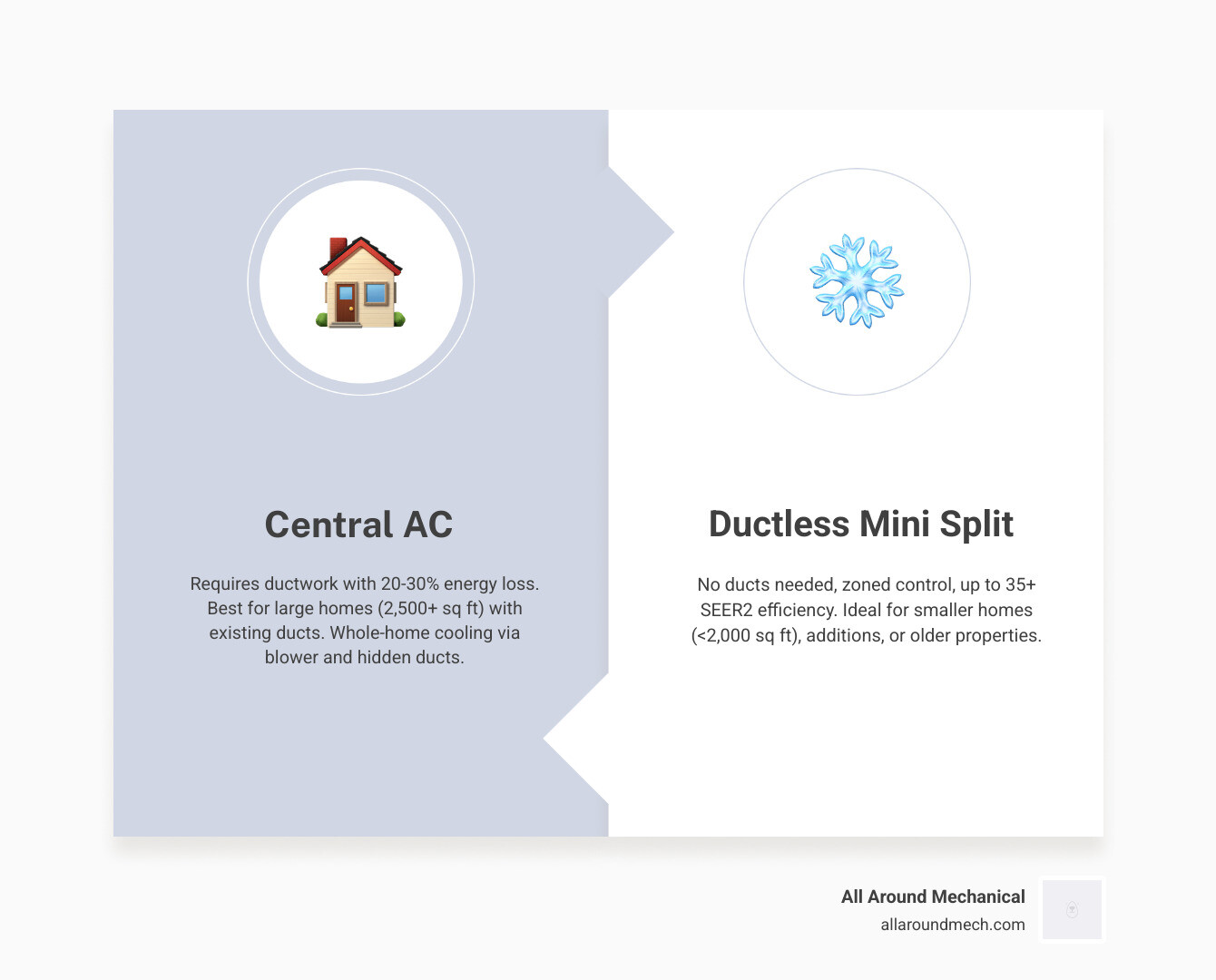
The central ac vs ductless mini split comparison comes down to one key factor: your home’s existing ductwork.
| Factor | Central AC | Ductless Mini Split |
|---|---|---|
| Requires ductwork | Yes | No |
| Best for home size | 2,500+ sq ft | Under 2,000 sq ft |
| Energy efficiency (SEER2) | Up to 26 | Up to 35+ |
| Zoned temperature control | Add-on cost | Built-in |
| Heating capability | Paired with furnace | Built-in heat pump |
| Ideal for older homes / additions | No | Yes |
| Duct energy loss | 20-30% | None |
Both systems use refrigerant to move heat out of your home. Both can keep your family comfortable through a hot Southwest Washington summer. But they work very differently — and the right choice depends on your home’s layout, age, and infrastructure.
If your home in the Vancouver or Ridgefield area already has well-maintained ductwork, central AC is often the straightforward, cost-effective path. If your home has no ducts, a problem room, or a new addition, a ductless mini split can deliver better efficiency with less hassle.
Neither system is universally better. The wrong choice — especially one based on contractor preference rather than your home’s actual needs — can mean years of wasted energy costs. This guide breaks down everything you need to know to make a confident, informed decision.
Understanding the Central AC vs Ductless Mini Split Comparison
To truly weigh your options, we need to look at how these systems move heat. Both systems rely on a cycle of compression and expansion using refrigerant. An outdoor condenser unit houses the compressor, which pumps refrigerant through copper lines to an indoor coil. As warm indoor air passes over this cold evaporator coil, the refrigerant absorbs the heat and carries it back outside to be released.
While the “guts” of the cooling process are similar, the way they distribute that cool air throughout your Ridgefield or Brush Prairie home is where they part ways. Central systems use a massive network of hidden pathways, while ductless systems deliver comfort directly into the room. For a deeper dive into the fundamentals, check out A Complete Guide to Choosing the Best Air Conditioning System for Your Home.
How Traditional Central Air Conditioning Works
Central air is the “invisible” workhorse of the HVAC world. It relies on a single, powerful indoor air handler or a blower motor integrated into your furnace. This motor pushes conditioned air through a web of supply ducts to every room in the house. Simultaneously, return ducts pull warm air back to the system to be cooled again.
This setup is ideal for maintaining a uniform temperature across a large floor plan. Because the equipment is tucked away in a crawlspace, attic, or basement, the only things you see in your living areas are the floor or ceiling vents. In areas like Brush Prairie, many homeowners prefer Central HVAC Services Brush Prairie WA because their homes were built with this infrastructure already in place.
The Mechanics of a Ductless Mini Split System
A ductless mini split skips the “middleman” of ductwork. Instead of one large indoor unit, it uses smaller, wall-mounted or ceiling-recessed “heads” in individual rooms. These heads are connected to the outdoor unit by small refrigerant lines and power cables that only require a three-inch hole in the exterior wall.
Because there are no ducts, there is no “duct loss”—the energy wasted when cool air leaks out of gaps in the attic or basement pipes. Mini splits also use advanced inverter technology, allowing the compressor to speed up or slow down precisely to meet the cooling demand. This is one of the primary The Benefits of Ductless Air Conditioning, as it prevents the constant “on-off” cycling that wastes electricity in older central systems.
Energy Efficiency and Performance Differences
In 2026, energy efficiency is more than just a buzzword; it’s a necessity for managing utility bills in Southwest Washington. The primary metric we use is SEER2 (Seasonal Energy Efficiency Ratio 2). While modern central AC systems have made great strides, reaching up to 26 SEER2, ductless mini splits are the reigning champions, with some models achieving staggering ratings of 35 to 42 SEER2.
The disparity often comes down to the delivery method. According to the U.S. Department of Energy, typical duct systems lose 20% to 30% of conditioned air through leaks, gaps, and poor insulation. This means even a high-efficiency central unit can perform like a much lower-rated system if the ducts aren’t perfect. You can learn more about how age impacts these numbers in our guide on Mini-Split System Age and Efficiency.
Efficiency Factors in a Central AC vs Ductless Mini Split Comparison
When we perform a central ac vs ductless mini split comparison for a client, we look at “part-load operation.” A central AC is often an all-or-nothing system. If you only want to cool your upstairs home office while you work, a central system still has to blow air through the entire house.
A mini split allows for true zoning. You can turn off the units in guest rooms or the living room and only pay to cool the space you are actually using. This targeted cooling can cut your energy consumption by 25% to 40% compared to a traditional ducted setup.
Heating Capabilities and Year-Round Comfort
One of the most significant advantages of modern mini splits is that they are almost always heat pumps. This means they can reverse the cooling process to provide highly efficient heat during our chilly Washington winters. Modern “cold-climate” mini splits can maintain high heating capacity even when outdoor temperatures drop toward zero degrees.
Central systems can also be heat pumps, but they are often paired with a gas furnace in what we call a “dual-fuel” system. This gives you the efficiency of a heat pump for moderate days and the raw power of a furnace for the coldest snaps. However, for homes without gas lines, Ductless Mini-Split Heating and Air Conditioning Brush Prairie WA offers a total year-round solution in a single package.
Installation Considerations for Southwest Washington Homes

Installation is where the “hidden costs” of HVAC often lurk. If your home in Vancouver or Camas was built in the last 30 years, it likely has a duct system. Replacing a dead central AC unit with a new one is usually a straightforward process that takes about a day.
However, if those ducts are 40 years old, leaky, or undersized, simply “dropping in” a new unit won’t solve your comfort issues. In fact, installing new ductwork in an existing home can be a massive undertaking, involving cutting into drywall and losing closet space.
When to Choose Central Air for Your Property
Central AC is still the “gold standard” for many homeowners for three reasons:
- Aesthetics: You don’t have units hanging on your walls. Everything is hidden behind small, discreet vents.
- Air Filtration: Central systems use large, pleated filters (and can be upgraded with UV lights or HEPA filters) that clean the air for the entire house at once.
- Whole-Home Uniformity: If you want every square inch of your 3,000-square-foot home to be exactly 72 degrees, central AC is designed for that specific task.
For more tips on choosing, see How to Choose the Best Air Conditioner for Your Home in 2023.
Why a Ductless Mini Split Comparison Favors Specific Home Layouts
We often recommend mini splits for “problem” areas or unique home styles. Older homes in areas like Ridgefield or La Center that were built before central air was standard often lack the space for bulky ductwork. In these cases, a mini split is a lifesaver.
They are also the perfect solution for:
- Garage Conversions: Keeping your new home gym or workshop cool without taxing your main house system.
- Attic Suites: Attics are notoriously hard to cool with central AC because they are at the end of the duct run and surrounded by heat.
- Slab-on-Grade Homes: If your home doesn’t have a basement or a crawlspace for ducts, a mini split avoids a messy and expensive retrofit.
Our team provides specialized Ductless HVAC Service Ridgefield Vancouver WA to ensure these systems are sized perfectly for these unique spaces.
Maintenance, Longevity, and Air Quality
Both systems require love and attention to reach their full lifespan, which is typically 15 to 20 years for central AC and up to 25 years for high-quality mini splits.
Central AC maintenance focuses on the “unseen.” You need to change the large furnace filter every 1 to 3 months and have your ducts professionally cleaned every few years to prevent dust and allergen buildup. Mini splits require more frequent but simpler maintenance. The small filters inside the wall units should be rinsed under a tap every 2 to 4 weeks during heavy use.
When it comes to brands, we often highlight Daikin Ductless systems for their reliability and advanced features. Regardless of the brand, the Benefits of Installing Mini-Split AC include a system that is often easier to repair because each unit operates independently. If one unit in the bedroom has an issue, the unit in the living room keeps right on running.
Frequently Asked Questions about Cooling Systems
Are mini splits quieter than central air?
Yes, significantly. In a central AC system, you often hear the “whoosh” of air moving through the ducts and the loud clatter of the outdoor unit kicking on. Indoors, mini split heads operate at decibel levels between 19 and 26 dB—that is literally softer than a whisper. The outdoor units are also much quieter, meaning you can sit on your patio without the roar of a compressor drowning out your conversation.
Can I use a mini split for my whole house?
Absolutely. While many people think of them as single-room solutions, “multi-zone” systems allow one outdoor condenser to power up to five or eight indoor heads. This allows you to create a custom comfort plan for every room in the house. If you’re looking for a HVC Camas WA Ductless Air Conditioner, we can design a multi-zone layout that covers your entire property efficiently.
Do mini splits qualify for tax credits in 2026?
In 2026, many high-efficiency mini split heat pumps qualify for significant federal tax credits under the Inflation Reduction Act. Homeowners can often claim up to $2,000 annually for qualified heat pump installations. Additionally, local utility companies in Southwest Washington frequently offer rebates for switching from inefficient electric baseboard heat or older AC units to high-SEER2 ductless technology.
Conclusion: Finding Your Ideal Comfort Solution in Vancouver, WA
Choosing between central air and a mini split isn’t about finding the “best” system—it’s about finding the best system for your home. At All Around Mechanical, we’ve spent years helping our neighbors in Vancouver, Ridgefield, Battle Ground, and across Southwest Washington navigate this exact decision.
Whether you need a powerful central AC for a new construction project in Camas or a whisper-quiet mini split for a historic home in Washougal, we prioritize your comfort and your budget. We believe in providing exceptional service at competitive prices, ensuring that every family we serve enjoys a cool, healthy indoor environment.
Don’t leave your summer comfort to chance or a “one-size-fits-all” contractor. Schedule your professional HVAC consultation today and let us help you build the perfect cooling strategy for your home.