

 (360) 896-2829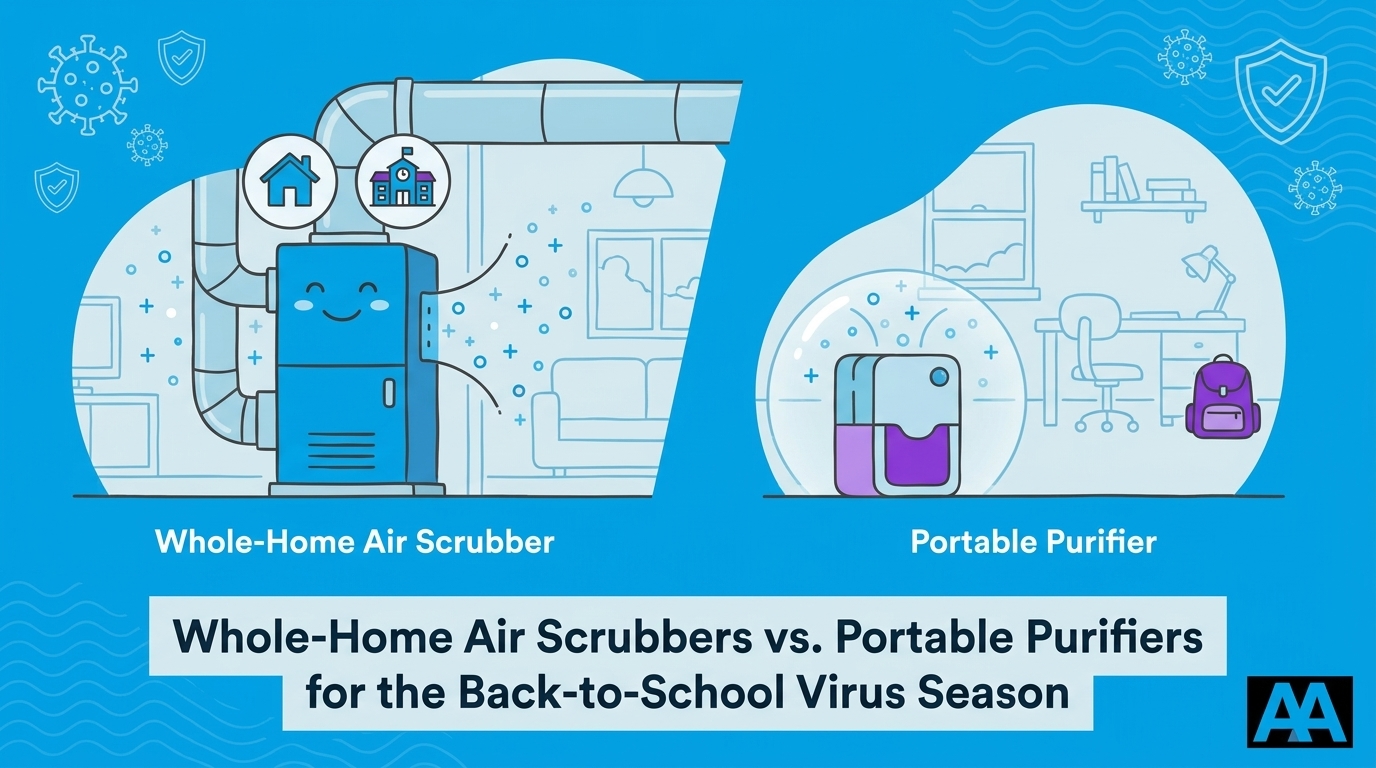
Are You Ready for the Inevitable Back-to-School Germ Surge?
Are you weighing the benefits of Whole-Home Air Scrubbers vs. Portable Purifiers for the Back-to-School Virus Season? As August winds down and children return to crowded classrooms, the sudden influx of circulating germs into your home is practically guaranteed. It happens every single year. One week the house is healthy, and the next, a seemingly endless cycle of sniffles, coughs, and fevers begins to pass from one family member to another. For busy households navigating the late-summer back-to-school transition, managing indoor air quality quickly becomes a top priority, but finding a solution that actually works without adding daily chores to your plate is the real challenge.
The core decision usually comes down to two distinct paths: managing air quality room-by-room by purchasing multiple standalone HEPA units, or upgrading your central heating and cooling system with a single, integrated inline HVAC air scrubber. Both approaches aim to reduce airborne pathogens, but they operate on entirely different scales and require vastly different levels of ongoing homeowner involvement. When you invest in comprehensive IAQ services, you are looking for a strategy that actively protects your family rather than just reacting to the latest seasonal bug. Understanding the operational realities of each method is the first step toward creating a healthier home environment that supports your family’s busy lifestyle instead of complicating it.
Why the Pacific Northwest Climate Accelerates Indoor Air Concerns
Indoor air quality is heavily influenced by outdoor weather patterns, and the climate in the Pacific Northwest creates a unique set of challenges as summer fades. In Ridgefield WA, the transition from August to October brings a rapid drop in average temperatures and a significant increase in damp, cool weather. While other regions might enjoy open windows and fresh cross-breezes well into November, local homeowners are forced to shut their windows and seal up their homes much earlier in the season to keep out the chill and moisture.
This early shift indoors triggers what experts call the “closed window effect.” Without natural ventilation, your home becomes a tightly sealed envelope. According to the Environmental Protection Agency (EPA), indoor air can be two to five times more polluted than outdoor air when a house is closed off from outside circulation. Every time someone sneezes, coughs, or simply exhales, those microscopic particles remain trapped inside the living space, continually cycling through the rooms.
This climate reality directly collides with the peak transition period for rhinoviruses and enteroviruses. Just as kids are bringing these germs home from school, the house is being sealed up tight for the fall. The combination of increased pathogen introduction and decreased natural ventilation means that airborne viruses reach higher concentrations much faster. Without an active mechanical strategy to filter or neutralize these contaminants, your family is left breathing recycled, stagnant air precisely when they need clean air the most.
The Room-by-Room Approach: Evaluating Portable HEPA Purifiers
For many homeowners, the immediate reaction to the late-summer back-to-school transition is to purchase portable HEPA (High-Efficiency Particulate Air) purifiers. These standalone units are widely available, plug directly into a standard wall outlet, and can be relatively effective at capturing airborne particles within a confined space. However, evaluating them for a whole-house strategy requires looking beyond the marketing claims on the box.
The most critical limitation of a portable purifier is its square footage rating. Most standard consumer units are designed to handle 300 to 500 square feet under ideal conditions. This means a single unit is typically only capable of treating a single bedroom or a small, enclosed home office. Furthermore, these devices require completely unobstructed airflow. If you place a purifier behind a sofa, tuck it into a corner, or block its intake with furniture, its effectiveness drops dramatically.
- Pros of Portable Units: Lower upfront barrier to entry, easy to move from room to room, and no professional installation required.
- Cons of Portable Units: Limited coverage area, significant floor space requirements, noticeable noise levels, and high ongoing maintenance.
The Hidden Costs of Multiple Standalone Units
To adequately protect a standard family home using the room-by-room approach, you would need a unit in the primary bedroom, one in every child’s room, one in the main living area, and potentially another in the kitchen or playroom. This compounding requirement introduces several hidden lifestyle costs:
Aesthetic and Spatial Footprint: Portable purifiers take up valuable physical floor space. In active family areas, they become obstacles to navigate around, and their power cords can create tripping hazards. Visually, having a plastic appliance humming in the corner of every room detracts from your home’s interior design.
Noise Pollution: To achieve their advertised air exchange rates, portable units must run their fans at medium to high speeds. This creates a constant, noticeable drone. During homework time, family movie nights, or light sleeping hours, the compounding noise of multiple units running simultaneously can become a significant nuisance.
Inconsistent Air Quality: Because these units only treat the air in their immediate vicinity, the air quality fluctuates wildly as you move through the house. Walking from a purified bedroom into an untreated hallway or bathroom exposes you to the very airborne contaminants you are trying to avoid.
The Whole-Home Solution: How Inline HVAC Air Scrubbers Work
Instead of trying to manage air quality piecemeal, an inline HVAC air scrubber integrates directly into your home’s central heating and cooling ductwork. This centralized approach shifts the strategy from localized trapping to comprehensive, active treatment of the entire home’s air supply.
Whenever your HVAC system’s fan is running, 100 percent of the air circulating through your home passes through the scrubber before being pushed back into your living spaces. This provides continuous, invisible protection that operates silently in the background. Homeowners in Ridgefield WA who choose this route often report a dramatic improvement in overall air freshness, alongside a noticeable reduction in lingering odors and airborne dust.
The technology behind the clean:
- Active Neutralization: Unlike passive HEPA filters that merely trap particles, advanced air scrubbers use active technology to neutralize threats. As air passes through the unit, it is exposed to specialized treatments.
- UV-C Light Integration: Many premium scrubbers utilize high-intensity UV-C germicidal lights. This specific wavelength of ultraviolet light disrupts the DNA and RNA of viruses, bacteria, and mold spores, rendering them inert and unable to replicate.
- Ionization Processes: Some systems also release charged ions into the ductwork. These ions attach to microscopic particles—including viruses and allergens—causing them to clump together. Once clumped, they become large enough for your standard HVAC filter to easily catch and remove them from circulation.
- Zero Floor Space: Because the entire unit is installed out of sight in your attic, basement, or utility closet alongside your furnace or air handler, it requires absolutely zero floor space in your living areas. Your home remains uncluttered.
Maintenance and Lifestyle Impact for Busy Parents
The true cost of any home appliance is measured not just in its purchase price, but in the ongoing time and effort required to keep it running effectively. For busy parents managing the late-summer back-to-school transition, time is a precious commodity. The lifestyle impact of your chosen air quality solution is often the deciding factor.
Managing a fleet of portable HEPA purifiers means tracking and purchasing four or five different filter sizes, often on varying replacement schedules depending on how frequently each unit is used. It means pulling units apart, vacuuming pre-filters, and swapping out expensive HEPA cartridges multiple times a year. If you forget to maintain even one unit, that specific room loses its protection.
In contrast, an inline air scrubber serves as a premium, fully integrated whole-home solution that offers superior long-term lifestyle value and convenience. It is the definition of a “set it and forget it” upgrade. Because it works in tandem with your central HVAC system, its maintenance is streamlined into your regular seasonal tune-ups.
| Feature Comparison | Multiple Portable Purifiers | Inline HVAC Air Scrubber |
|---|---|---|
| Coverage Area | 300-500 sq ft per unit (localized) | 100% of the home’s circulated air |
| Maintenance Routine | Changing 4-5 different filters regularly | 1 central system checked during seasonal HVAC tune-ups |
| Living Space Required | Takes up floor space in every room | Zero (installed in the ductwork) |
| Noise Level | Noticeable fan drone in living areas | Completely silent in living spaces |
| Pathogen Treatment | Passive trapping (HEPA) | Active neutralization (UV-C / Ionization) |
Furthermore, an air scrubber enhances the performance of your existing central filtration. By understanding the best air filters and MERV ratings, you can pair your scrubber with a high-quality pleated filter at the return grille. The scrubber neutralizes the microscopic pathogens, while the standard filter catches the larger dust and dander, creating a highly efficient, low-maintenance ecosystem.

Why Upgrading Standard Filters Isn’t Enough for Virus Protection
A common misconception among homeowners in Ridgefield WA is that they can achieve the same results as an air scrubber simply by buying the thickest, highest-rated filter available at the hardware store and sliding it into their furnace. While upgrading your filter is generally a good practice for reducing dust, it is not a standalone solution for virus protection, and it can actually cause severe damage to your HVAC system if done incorrectly.
The difference between passive and active treatment: Standard HVAC filters rely on passive filtration. They use tightly woven fibers to physically block particles from passing through. Viruses, however, are incredibly small—often measuring less than 0.1 microns in diameter. To catch something that small, a filter must be woven incredibly tight, which leads to the next major issue: airflow restriction.
The danger of restricted airflow: Heating and cooling systems are engineered to move a specific volume of air, measured in cubic feet per minute (CFM). When you install a highly restrictive filter—such as a MERV 13 or higher—without modifying your ductwork, you create immense static pressure. The blower motor has to work twice as hard to pull air through that dense barrier. This is exactly why standard MERV 13 filters can choke your system, leading to frozen evaporator coils in the summer, overheated heat exchangers in the winter, and premature blower motor failure.
The active advantage: An inline air scrubber provides the solution to this airflow dilemma. Because it uses UV-C light or ionization to neutralize viruses, it does not rely on a dense, restrictive physical barrier. It allows your HVAC system to breathe freely and operate at peak efficiency while still providing hospital-grade pathogen reduction throughout the home.
Making the Right Choice for Your Household’s Air Quality
Deciding between localized, high-maintenance portable units and a centralized, low-maintenance air scrubber ultimately comes down to your family’s lifestyle and long-term goals. The American Society of Heating, Refrigerating and Air-Conditioning Engineers (ASHRAE) guidelines emphasize that effective airborne infection control requires consistent, reliable air exchange and treatment—something that is difficult to achieve with a mismatched collection of portable fans.
As you navigate the late-summer back-to-school transition, use this quick checklist to evaluate your household’s readiness for a whole-home upgrade:
- Assess your current HVAC setup: Do you have a central forced-air system with accessible ductwork near the indoor air handler? If so, your home is likely a prime candidate for an inline scrubber.
- Evaluate your floor plan: Does your home have an open concept design, or are the bedrooms spread out across multiple floors? Centralized systems treat all connected spaces evenly, whereas open floor plans severely limit the effectiveness of portable units.
- Calculate the time cost: Are you prepared to add filter tracking, purchasing, and changing for multiple standalone units to your monthly chore list?
- Prioritize peace of mind: Do you want the assurance that the air is being actively cleaned every time the thermostat calls for heating or cooling, without you having to push a single button?
Investing in whole-home air quality is about more than just surviving the current virus season; it is about creating a permanently healthier, more comfortable living environment for your family.
Secure Continuous Protection Before Virus Season Peaks
The window between the start of the school year and the peak of the fall virus season is narrow. Waiting until illness is already cycling through your household means you have missed the opportunity for preventative defense. Now is the time to take proactive steps to secure your home’s air quality.
Scheduling a professional indoor air quality assessment allows a local expert to evaluate your existing ductwork and recommend the exact inline scrubber technology that fits your system’s specifications. The installation process is typically fast, non-invasive, and seamlessly integrates with your current equipment. You can ensure your family enjoys continuous, silent protection by exploring HVAC solutions to reduce allergens and airborne viruses before the season fully sets in, giving you the ultimate peace of mind when it matters most.
FAQ
Is a whole home air scrubber better than a portable purifier?
The short answer is yes, for comprehensive home protection. A whole-home air scrubber is integrated directly into your central ductwork, allowing it to treat 100 percent of the air circulating through your house. Portable purifiers are only effective in the single room where they are placed and require constant maintenance. For busy households, the centralized approach offers far superior convenience and consistent air quality.
Do HVAC air scrubbers kill viruses?
Yes, many advanced HVAC air scrubbers actively neutralize viruses rather than just trapping them. Systems equipped with high-intensity UV-C germicidal lights disrupt the DNA and RNA of airborne pathogens, rendering them inert. When combined with ionization technology, these scrubbers provide a highly effective defense against circulating seasonal viruses.
How many portable air purifiers do I need for a whole house?
To effectively treat a whole house, you generally need one appropriately sized portable purifier for every enclosed room, including bedrooms, living rooms, and home offices. Because standard units only cover 300 to 500 square feet and cannot pull air through walls or down hallways, outfitting an entire home often requires purchasing and maintaining four to six separate devices.
How much maintenance does an HVAC air scrubber need?
An HVAC air scrubber is designed to be a low-maintenance, “set it and forget it” solution. The primary maintenance involves replacing the UV-C bulb or internal cell, which typically only needs to be done once every one to two years depending on the model. This simple swap is easily incorporated into your regular seasonal HVAC tune-up by a professional technician.
Do whole-home scrubbers make noise in the living areas?
No, whole-home scrubbers operate completely silently within your living spaces. Because the unit is installed directly into the ductwork near your central air handler—usually located in an attic, basement, or utility closet—you will not hear it running. This is a significant advantage over portable purifiers, which generate noticeable fan noise in bedrooms and living rooms.
Can an inline air scrubber be added to an existing HVAC system?
Absolutely. Inline air scrubbers are specifically designed to be retrofitted into existing central heating and cooling systems. A professional HVAC technician can cut a small access point into your supply or return plenum and mount the scrubber directly into the airflow path, seamlessly integrating it with your current equipment without requiring major ductwork modifications.