

 (360) 896-2829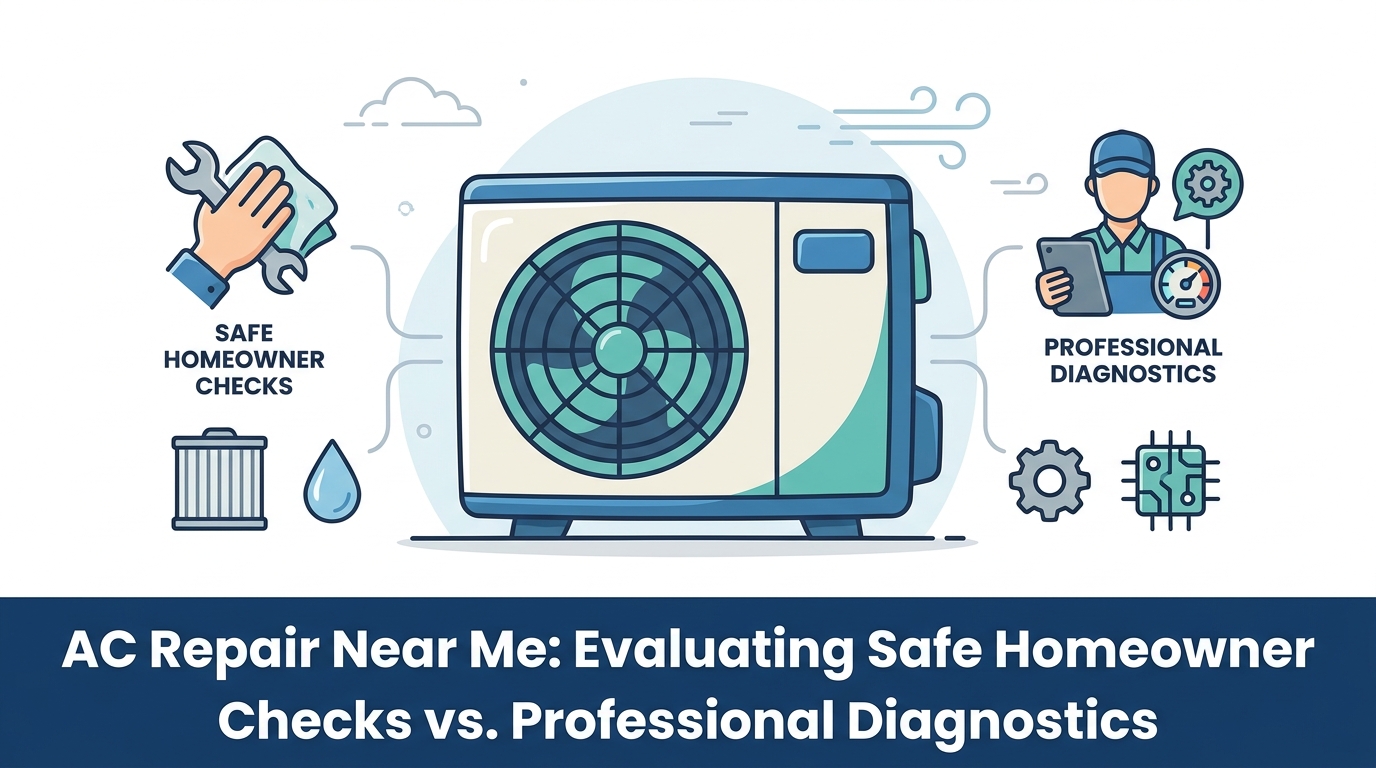
Navigating AC Failures: When to Troubleshoot and When to Call an Expert
Your air conditioner is running nonstop, but the house still feels uncomfortably warm. When a cooling system struggles during a hot afternoon in the local area, finding the right path forward often starts with options comparisons for homeowners who want to know what they can safely check versus what requires an expert. At our business, our team typically sees that the immediate frustration of an unresponsive system can tempt anyone to start taking panels off the unit, but knowing what not to touch is just as important as knowing what to check.
This guide provides an objective, criteria-based evaluation framework to help you make an informed decision. By clearly defining the boundaries between service option A (safe preliminary homeowner checks) and service option B (required professional diagnostics), you can remove the guesswork from the repair process. This approach protects your equipment from accidental damage, keeps you safe from high-voltage hazards, and ensures you only call for professional help when a true mechanical or electrical failure has occurred.
Assessing the Severity of Your Cooling System’s Symptoms
Before taking any action, you need to evaluate the specific symptoms your cooling system is displaying. There is a significant difference between a system that is running inefficiently and one that is completely unresponsive. Reviewing common operational anomalies helps you categorize the issue and decide whether to proceed with safe checks or immediately halt operation to prevent further damage.
If you notice unusual noises like grinding, squealing, or loud banging, these are clear indicators of mechanical distress. Similarly, if the system is short-cycling—turning on and off rapidly every few minutes—the internal components are being subjected to excessive wear. In our experience, recognizing these early warning signs of an AC repair problem provides the foundational context you need to choose the right service approach. Once you identify the symptom, you can apply our decision-making framework to determine your next steps.
Categorizing Airflow and Temperature Inconsistencies
Measuring the temperature drop: One of the most effective ways to assess your system’s performance is to check the temperature difference between the supply vents (where cold air comes out) and the return vents (where warm air goes in). Under normal conditions, this temperature drop should be between 15 and 20 degrees Fahrenheit. If the difference is significantly lower, the system is circulating air but failing to extract heat properly.
Warm air versus no air: It is also critical to distinguish between warm air blowing from the vents and no air blowing at all. If you feel a strong stream of warm air, the indoor blower motor is functioning, but the outdoor compressor or refrigerant cycle is likely compromised. If you feel absolutely no air coming from the vents, the issue is often tied to the indoor blower motor, a frozen evaporator coil blocking the airflow, or a severe blockage in the ductwork. Categorizing these inconsistencies dictates whether a simple filter change might help or if professional intervention is required.
Safe Preliminary Checks Every Homeowner Can Perform
When evaluating service option A versus service option B, Option A encompasses the observational, foundational checks that require no mechanical disassembly. These are the specific, safe actions a homeowner can take without violating safety standards, risking injury, or voiding equipment warranties. Before assuming the worst, our technicians at our business recommend walking through this preliminary checklist, as we often see these simple steps resolve immediate issues.
- Inspect and replace the air filter: According to data from the Department of Energy, clogged, dirty filters block normal airflow and significantly reduce a system’s efficiency. A severely restricted filter can even cause the indoor evaporator coil to freeze solid. Locate your return air filter, pull it out, and hold it up to a light source. If you cannot see light passing through the media, replace it immediately with a fresh filter of the correct size.
- Verify all thermostat settings: It sounds overly simple, but thermostat misconfigurations account for a surprising number of cooling failures. Ensure the thermostat is explicitly set to the “cool” position, not “heat” or “off.” Verify that the fan setting is switched to “auto” rather than “on.” If the fan is set to “on,” the blower will run constantly, circulating unconditioned, warm air between cooling cycles. Finally, if the thermostat screen is blank or flashing, replace the batteries with fresh ones.
- Check the dedicated circuit breakers: Your air conditioning system relies on two separate power sources: one for the indoor air handler and one for the outdoor condenser. Locate your home’s main electrical panel and look for the labeled HVAC breakers. If a breaker has tripped, it will typically rest in a middle position between “on” and “off.” To safely reset it, push the switch firmly to the “off” position until you hear a click, and then push it back to the “on” position.
- Examine the outdoor unit for physical obstructions: Walk outside and visually inspect the condenser unit. It requires adequate airflow to dissipate heat. Ensure that no leaves, branches, tall grass, or debris are blocking the metal fins. Maintain a clearance of at least two feet around the entire unit. Do not attempt to unscrew the protective grilles or clean the internal components yourself.
These steps represent the absolute limit of safe homeowner maintenance. They are entirely observational and involve no tools, wiring, or chemical handling.
Side-by-Side Comparison: Homeowner Maintenance vs. Professional Diagnostics
To strip away industry jargon and clearly delineate responsibilities, this matrix provides a definitive, neutral comparison of safe homeowner checks (Option A) versus required professional diagnostics (Option B). Use this if/then framework to determine the appropriate action based on specific system symptoms.
| System Symptom | Option A: Safe Homeowner Action | Option B: Professional Diagnostic | Risk Factor of Unauthorized Repair |
|---|---|---|---|
| Weak airflow from vents | Check and replace dirty air filters; ensure all room vents are open. | Test blower motor voltage; inspect ductwork for severe leaks or collapses. | Damaging delicate blower wheel fins or voiding the motor warranty. |
| System completely unresponsive | Verify thermostat settings; replace batteries; check the electrical panel for a tripped breaker. | Test internal contactors, control boards, and low-voltage wiring continuity. | Exposure to fatal high-voltage electrical currents inside the cabinet. |
| Warm air blowing from vents | Ensure the thermostat fan is set to “auto” rather than “on.” | Perform electronic refrigerant leak detection; test compressor amp draw. | Illegal venting of regulated refrigerant chemicals into the atmosphere. |
| Ice forming on indoor or outdoor pipes | Turn the system completely off to allow the ice to thaw; replace the air filter. | Measure system superheat and subcooling; clear blocked condensate drains. | Puncturing the pressurized evaporator coil while attempting to scrape off ice. |
| Loud grinding or screeching noises | Turn the system off immediately at the thermostat. | Inspect fan motor bearings; evaluate compressor health; tighten internal mounts. | Allowing a failing motor to run until it completely destroys the compressor. |
This comparison highlights the critical boundary between general maintenance and mechanical repair. Crossing from Option A into Option B without the proper licensing and training introduces severe risk factors to both your personal safety and your property.

System Resets: How Long to Wait Before Seeking Help
The Problem: A pattern we see often at our business is homeowners assuming their air conditioner is completely broken when it fails to turn on immediately after a power outage, a thermostat adjustment, or a breaker reset. This leads to panic and premature service calls.
The Cause: Modern air conditioning compressors are equipped with internal delay mechanisms. These built-in timers are designed to protect the system from “short-cycling.” When an AC unit shuts off, the refrigerant pressure inside the system is highly unequal. If the compressor tries to start immediately against this high pressure, it can overheat, draw excessive electrical current, or sustain permanent mechanical damage. The delay gives the internal pressures time to equalize.
The Solution: Establish a strict chronological boundary. After resetting a breaker or adjusting the thermostat, wait a full 15 to 30 minutes before expecting cold air to flow from the vents. Do not repeatedly adjust the thermostat up and down during this waiting period, as this only resets the internal timer.
The Warning: If the system fails to resume normal operation after one safe reset cycle, the troubleshooting phase is officially over. Furthermore, if you reset a tripped circuit breaker and it immediately trips again, stop touching it. A breaker that continuously trips is indicating a dead short, a failing compressor, or compromised wiring. Repeatedly forcing it back on is a severe fire hazard and indicates an immediate need for professional diagnostics.
Understanding the Boundary: When EPA Regulations Require a Professional
Fulfilling the “Option B” side of the comparison means understanding the legal, environmental, and safety boundaries that mandate professional intervention. Air conditioning repair is not simply a matter of having the right tools; it is heavily regulated for public safety.
Refrigerant handling laws: The most rigid boundary involves the chemical refrigerant that cools your home. Handling, recovering, or charging AC refrigerant requires Section 608 certification from the Environmental Protection Agency (EPA). These chemicals operate under extreme pressure and pose severe environmental hazards if vented into the atmosphere. Furthermore, liquid refrigerant can cause instant, severe frostbite if it contacts human skin. If your system is exhibiting symptoms like hissing noises near the outdoor unit, completely frozen evaporator coils, or a faint, sweet chemical smell, these are strict indicators of a refrigerant leak. A homeowner cannot legally or safely recharge a leaking system.
High-voltage electrical dangers: The electrical components inside an AC condenser are equally hazardous. The system utilizes capacitors—cylindrical devices that store massive amounts of electrical energy to help the heavy compressor motor start. A dual-run capacitor can hold hundreds of volts of electricity, and it retains this lethal charge long after the power has been disconnected at the breaker. Interacting with capacitors, contactors, or control boards without proper diagnostic meters and discharging tools is incredibly dangerous.
Professional service in these scenarios is not an optional upgrade or an upsell; it is a regulatory and safety necessity. Once a problem moves beyond the air filter and the thermostat, professional diagnostics are required to ensure the system is repaired safely and legally.
How Pacific Northwest Heat Waves Accelerate the Need for Immediate Action
While the Pacific Northwest is generally known for mild, pleasant summers, the climate reality has shifted in recent years. Sudden temperature spikes and intense heat domes drastically increase residential cooling loads, changing the calculus of when to seek professional help.
When extreme heat events settle over areas like Ridgefield and Vancouver, our team at our business frequently responds to calls where the outdoor ambient temperature has soared well above the design limits of older HVAC equipment. These rapid temperature shifts can turn minor system inefficiencies—like a slightly dirty coil or a weakening capacitor—into complete operational failures within a matter of hours. A system that struggles slightly on an 80-degree day will often shut down entirely when forced to run continuously in 100-degree heat.
During these periods of extreme weather, the window for delayed troubleshooting shrinks significantly. Spending three days trying to diagnose a weak airflow issue yourself allows the home’s thermal mass to heat up, making it exponentially harder for the system to recover once it is finally fixed. Fast, reliable local expertise is critical because our team at our business understands exactly how these sudden Pacific Northwest heat waves stress residential cooling systems in the local area. We know that swift professional diagnostics are necessary to restore comfort before indoor temperatures reach unsafe levels.
Frequently Asked Questions About AC Troubleshooting and Repair
What should I check before calling an AC repairman?
Before calling for professional service, verify that your thermostat is set to “cool” and the fan is on “auto.” Next, check your electrical panel to ensure the dedicated HVAC circuit breakers have not tripped. Finally, inspect your indoor air filter; a severely clogged filter can restrict airflow enough to shut the entire system down. If these three safe preliminary checks do not resolve the issue, it is time to schedule a diagnostic appointment.
When should I call a professional for AC repair?
You should contact a licensed professional immediately if you hear loud grinding or squealing noises, smell burning electrical odors, or see ice forming on the refrigerant lines. Additionally, if you have completed the basic homeowner checks (filter, thermostat, breaker) and the system remains unresponsive, professional diagnostics are required. Never attempt to open the equipment cabinet or handle internal wiring yourself.
Can I fix my AC myself?
You can perform basic maintenance like changing the air filter, replacing thermostat batteries, and keeping the area around the outdoor unit clear of debris. However, you cannot legally or safely perform mechanical or electrical repairs. Handling refrigerant requires EPA Section 608 certification, and diagnosing internal components exposes you to lethal high-voltage electricity stored in the system’s capacitors.
When is an AC repair considered an emergency?
An AC failure becomes an emergency when indoor temperatures reach levels that threaten the health and safety of vulnerable occupants, such as the elderly, infants, or pets. It is also an emergency if the system is creating a direct hazard, such as emitting sparks, producing smoke, or leaking water extensively through a ceiling. During severe summer heat domes, a complete lack of cooling should be treated with high urgency.
How long should I wait after resetting my AC breaker?
After resetting a tripped circuit breaker or restoring power after an outage, you should wait a full 15 to 30 minutes before expecting the system to produce cold air. Modern compressors have built-in time delays to allow internal refrigerant pressures to equalize, preventing the motor from starting under extreme stress. If the system does not resume normal operation after this waiting period, do not reset the breaker again.
Why is my AC running but not cooling the house?
If your system is running constantly but the air feels warm, the most common culprits are a dirty air filter blocking airflow, a frozen indoor evaporator coil, or a refrigerant leak. It can also indicate a failed outdoor compressor that is no longer pumping refrigerant through the cycle. Turn the system off to prevent further mechanical damage and contact a professional to diagnose the specific cause.
Making the Right Choice for Your Home’s Comfort and Safety
Navigating an air conditioning failure comes down to recognizing your limits. Completing safe preliminary checks—like verifying thermostat settings, inspecting the electrical panel, and replacing dirty air filters—empowers you as a homeowner while protecting your equipment from unnecessary wear. However, recognizing the definitive boundary of professional repair is what ensures long-term system health and compliance with vital safety regulations.
When comparing service option A versus service option B, the critical factor is safety. Once the basic checklist is exhausted without success, it is time to rely on trusted local expertise. If your cooling system exhibits signs of mechanical failure, electrical issues, or refrigerant loss, our team at our business is ready to provide the clear, if/then recommendations necessary to restore your home’s comfort reliably and safely.