

 (360) 896-2829
When Your HVAC Quits: How to Stay Safe During a Heating or Cooling Emergency
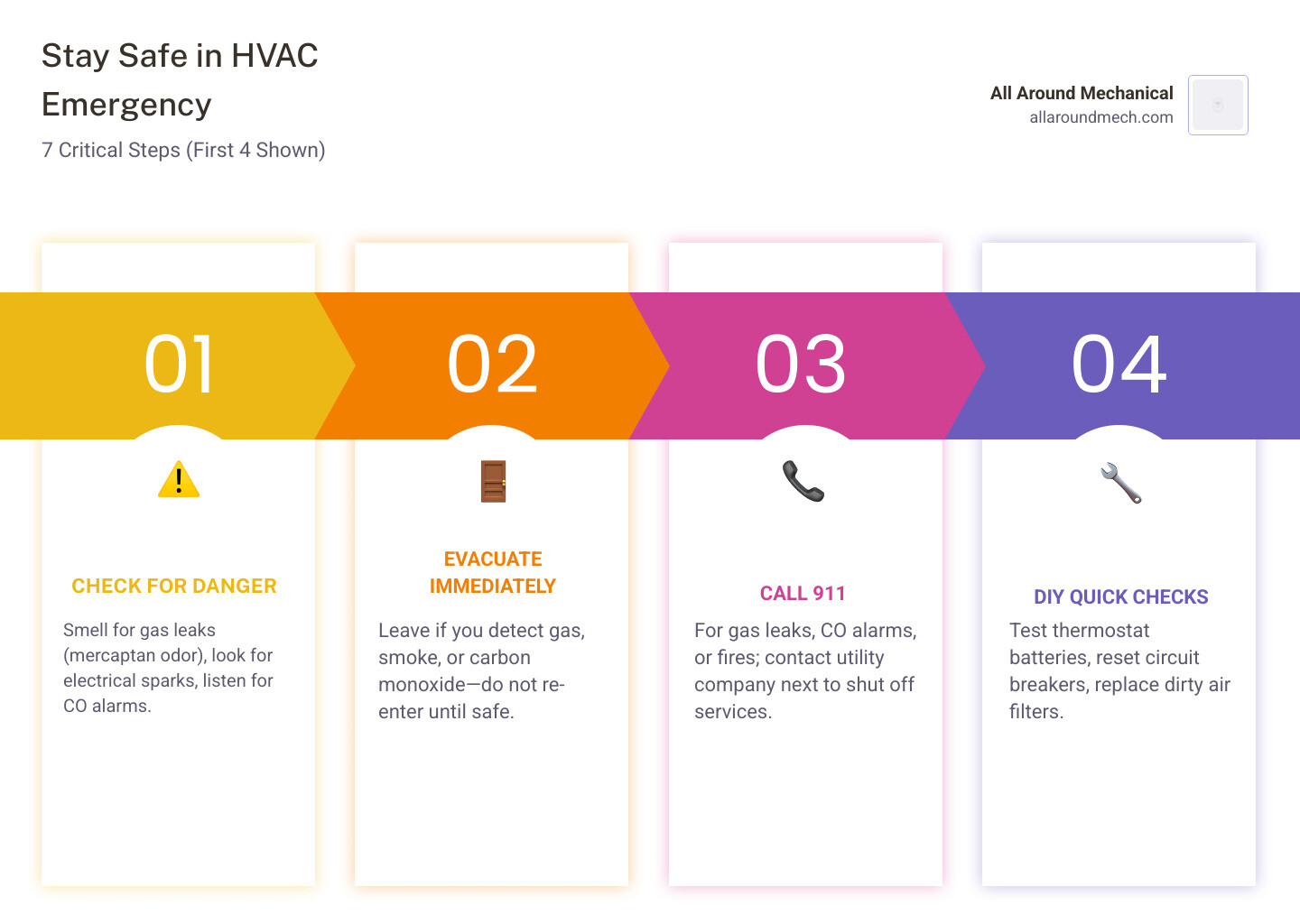
Knowing how to stay safe during a heating or cooling emergency could be the difference between a stressful afternoon and a genuine health crisis. Here’s a quick summary of the most important steps:
- Check for danger first — smell for gas, look for sparks, listen for your CO alarm
- Evacuate immediately if you detect gas, smoke, or carbon monoxide
- Call 911 for gas leaks or CO alarms; call your utility company next
- Do quick DIY checks — thermostat batteries, circuit breakers, air filters — before calling a tech
- Protect vulnerable people and pets — move them to a safe temperature environment right away
- Find cooling or warming alternatives — cooling centers, space heaters, or a neighbor’s home
- Call a licensed HVAC professional for anything beyond basic troubleshooting
Heat is the leading weather-related killer in the United States, and Southwest Washington homeowners know that when temperatures spike past 100°F in summer — or drop below freezing in winter — a broken HVAC system stops being an inconvenience and starts being a safety emergency. Whether your AC dies during a July heatwave in Vancouver or your furnace quits on a bitter January night in Ridgefield, the first few minutes matter most.
Most people don’t think about what to do until it actually happens. And in a moment of stress, that’s exactly the wrong time to be figuring it out.
This guide from All Around Mechanical walks you through exactly what to do — step by step — so you can protect your family, your home, and your peace of mind when your system fails.
How to Stay Safe During a Heating or Cooling Emergency in Vancouver, WA
When your home’s climate control fails, the first thing we recommend is a “sensory sweep.” Before you worry about the temperature, you need to make sure the environment is actually safe to stand in. HVAC systems involve high-voltage electricity, pressurized refrigerants, and, in many Southwest Washington homes, flammable natural gas.

Start with your nose. Natural gas is naturally odorless, but utility companies add a chemical called mercaptan that gives it a distinct “rotten egg” smell. If you catch even a whiff of this near your furnace or vents, stop what you are doing. Do not flip any light switches or use your phone inside, as a tiny spark could ignite the gas.
Next, listen and look. Are there sparks flying from the outdoor condenser? Do you hear a loud, rhythmic banging or a high-pitched screeching? Is there a pungent, acrid smell like burning plastic or wire insulation? These are 8 Warning Signs That Indicate Your Hvac System Needs Emergency Repair and should never be ignored. Finally, check your Carbon Monoxide (CO) detectors. CO is a silent, odorless killer. If that alarm sounds, it means your furnace may have a cracked heat exchanger, leaking deadly exhaust into your living space.
Immediate Steps for How to Stay Safe During a Heating or Cooling Emergency
If you detect gas, smoke, or a CO alarm, your priority is evacuation. Get every person and pet out of the house immediately. Once you are at least 100 feet away — roughly the distance of a neighbor’s driveway — call 911. Only after emergency responders have cleared the scene should you worry about calling us for repairs.
For non-life-threatening failures, like a system that simply won’t turn on, you should still act quickly. Identify Ac Problems That Need Immediate Service such as significant water leaks. A clogged condensate drain can send gallons of water into your drywall or flooring, leading to expensive mold issues. Locate your main electrical breaker and the dedicated HVAC switch so you can cut power to the system if you see signs of electrical distress.
Essential Supplies for How to Stay Safe During a Heating or Cooling Emergency
We always suggest that our neighbors in Clark County keep a “Comfort Kit” ready. This kit is your bridge between the system failing and our technician arriving.
- A Digital Thermometer: Don’t rely on your “feeling.” You need to know when the indoor temperature hits 90°F in the summer or drops below 55°F in the winter, as these are critical safety thresholds.
- Air Quality Tools: If you have a ductless system, keep spare Signs Ductless Ac Needs Immediate Attention in mind, but also keep HEPA-rated portable air purifiers. These are vital if a failure happens during wildfire season.
- Power & Light: A battery-powered radio for weather alerts and a portable power bank for your phone.
- Hydration: Keep at least a three-day supply of water (roughly one gallon per person per day).
Troubleshooting Your System Before Calling for Emergency Service
It might surprise you to learn that roughly 25% of emergency service calls are resolved by simple checks that you can do yourself. Before you pay for an after-hours visit, run through this triage list.
| Symptom | Homeowner Check | Professional Fix |
|---|---|---|
| Blank Thermostat | Replace batteries; check for a tripped breaker. | Wiring repair or thermostat replacement. |
| AC Blowing Warm Air | Check for a dirty filter or debris on the outdoor unit. | Refrigerant leak repair or compressor service. |
| Furnace Blowing Cold Air | Check gas valve and pilot light (if applicable). | Ignitor or control board replacement. |
| System Won’t Start | Check the “Float Switch” in the drain pan for water. | Clearing a clogged condensate line. |
Simple Checks to Resolve Common Failures
Start with the thermostat. It sounds simple, but 40% of HVAC emergencies are actually thermostat malfunctions. If the screen is blank, swap the batteries. Ensure it’s set to “Cool” or “Heat” rather than just “Fan On,” which circulates room-temperature air without conditioning it.
Next, check your air filter. A filter so dirty you can’t see light through it can cause an AC coil to freeze into a block of ice or a furnace to overheat and shut down. If your AC is frozen, turn it “Off” but leave the “Fan” on to help it thaw—this can take 12 to 24 hours. Also, look for Signs Ac Needs Immediate Repair like a tripped circuit breaker. You can try resetting the breaker once. If it trips a second time, do not try again; it’s a fire hazard and requires a pro. You can find more DIY tips in our Hvac Troubleshooter guide.
Surviving the SW Washington Summer: Staying Cool Without AC
In May 2026, we are seeing more frequent temperature spikes in the Pacific Northwest. Heat is dangerous because it accumulates; indoor temperatures can rise 10 to 20 degrees in a single hour if the AC fails during a 100-degree day.
If the indoor temperature hits 85°F, it’s time to take active cooling measures. If it hits 90°F, we recommend that vulnerable populations — infants, the elderly, and those with chronic illnesses — relocate to a cooling center. In Vancouver, public libraries, malls, and designated community centers often serve as cooling stations. You can call 2-1-1 to find the nearest location.
Protecting Your Family and Pets During a Cooling Emergency
To stay safe at home, focus on “Solar Heat Gain.” Close all drapes and blinds on the sunny side of the house. You can even use cardboard or reflective foil on windows to block the sun’s rays. Use fans only if the temperature is below 90°F; above that point, fans just move hot air around and can actually increase dehydration.
Drink plenty of water even if you aren’t thirsty, and avoid caffeine or alcohol, which can dehydrate you faster. For pets, keep them on cool tile floors and never leave them in a room without airflow. If you need Emergency Ac Repair Solutions, we prioritize calls where health is at risk. Residents needing Emergency Ac Repair Brush Prairie Wa should reach out immediately if they have medically fragile family members.
Winter Safety: Keeping Warm During a Heating Failure
A heating failure in the middle of a Washington freeze is a race against the clock. Your home will lose heat quickly, and once the indoor temperature drops below 55°F, your plumbing is at risk.
The best way to stay warm is to “zone” your home. Pick one small room, preferably one with few windows, and gather the family there. Close the doors to the rest of the house to trap body heat. Layer your clothing—three thin layers are better than one thick one. If you are using a space heater, keep it at least three feet away from anything flammable (curtains, rugs, or furniture) and never leave it on while you sleep. If your heat pump is struggling, check our guide on Heat Pump Emergency Repairs to see if you should switch to “Emergency Heat” mode.
Preventing Property Damage During Extreme Cold
While you keep yourself warm, don’t forget your pipes. When the heat goes out and temperatures drop below 25°F, pipes in exterior walls can freeze and burst within hours. Open the cabinet doors under your kitchen and bathroom sinks to allow what little heat is left in the house to reach the plumbing.
We also recommend letting your faucets drip—just a slow trickle of cold water. This keeps water moving and relieves pressure, which is often what causes a pipe to actually burst. Block drafts by placing rolled-up towels at the base of doors and using plastic wrap over drafty windows. Taking these steps can save you thousands in water damage while you wait for Heat Pump Emergency Repairs.
Protecting Your Property and Vulnerable Family Members
Vulnerable groups require special attention during any HVAC emergency. Infants and young children cannot regulate their body temperatures as efficiently as adults. Similarly, seniors may have underlying conditions or take medications that make them more susceptible to heatstroke or hypothermia.
If someone in your home relies on medical equipment, like an oxygen concentrator or a home dialysis machine, a power-related HVAC failure is a life-threatening event. You should have a backup power source, such as a large battery station or a generator, and a pre-arranged plan to move to a facility with power. Always keep a list of 8 Warning Signs That Indicate Your Hvac System Needs Emergency Repair posted near your thermostat so every member of the family knows when to call for help.
Long-Term Preparedness and Maintenance
The best emergency is the one that never happens. Statistics show that homeowners who schedule regular maintenance are 50% less likely to experience a sudden breakdown. A poorly maintained system can lose up to 15% of its efficiency every year, which means it’s working harder and getting closer to a total failure every day.
We recommend a “Spring Tune-Up” for your AC and a “Fall Tune-Up” for your heating system. This allows us to catch Signs Ac Needs Immediate Repair — like a failing capacitor or a worn blower belt — before the peak season hits. A well-maintained system can last 15 to 20 years, whereas a neglected one might give out in just 8 to 10.
Frequently Asked Questions about HVAC Emergencies
When should I call 911 versus an HVAC professional?
Call 911 immediately if you smell gas (rotten eggs), see smoke or fire, or if your carbon monoxide alarm is sounding. These are life-threatening emergencies. Call an HVAC professional if your system has failed but there is no immediate threat of fire, explosion, or poisoning.
Is it safe to use my oven to heat my home?
No. Never use a gas oven or stove to heat your home. This creates a massive risk of carbon monoxide poisoning and is a major fire hazard. Use approved electric space heaters with tip-over protection instead.
How do I find a cooling center in Vancouver, WA?
In Vancouver and throughout Southwest Washington, you can call 2-1-1 or visit the Clark County website for a list of active cooling centers during heatwaves. Local libraries and malls are also excellent, free places to find air conditioning.
Conclusion
At All Around Mechanical, we’ve spent years serving our neighbors in Ridgefield, Vancouver, and across Southwest Washington. We know that an HVAC failure feels like a crisis, but by following these safety protocols, you can stay in control. Whether you’re in Battle Ground, Camas, or Washougal, our team is dedicated to providing exceptional service at competitive prices to get your home back to a safe temperature.
Don’t wait until the next heatwave or cold snap to think about your system. If you’ve noticed strange noises, weak airflow, or rising bills, reach out to us today. If you are currently facing a breakdown, we are here to help with Emergency Ac Repair Brush Prairie Wa and comprehensive services throughout the region. Stay safe, stay hydrated, and remember—we’re here when you need us most.