

 (360) 896-2829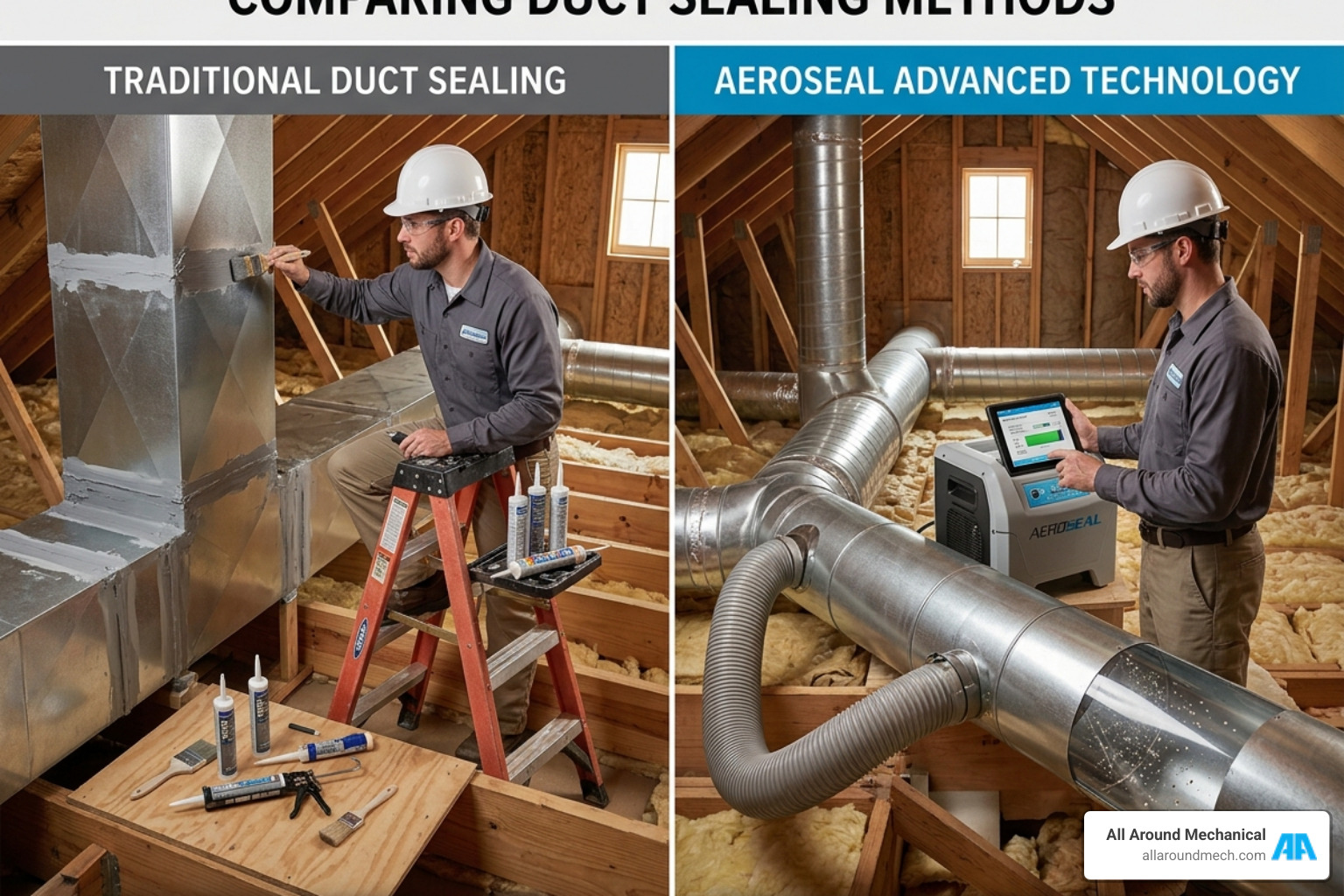
Why the Aeroseal vs Traditional Duct Sealing Comparison Matters for Southwest Washington Homeowners
The aeroseal vs traditional duct sealing comparison comes down to one core difference: traditional methods can only seal what a technician can physically reach, while Aeroseal seals your entire duct system from the inside — including the hidden leaks behind walls, in attics, and under floors.
Here’s a quick side-by-side breakdown:
| Factor | Traditional Duct Sealing | Aeroseal |
|---|---|---|
| How it works | Mastic or foil tape applied by hand to visible joints | Aerosolized polymer injected inside pressurized ducts |
| Leakage reduction | 60–70% of accessible leaks | Up to 90–95% of total leakage |
| Reaches hidden ducts | No | Yes |
| Verified results | Rarely measured | Before-and-after computer report |
| Durability | Varies by material and application | 10-year warranty; tested up to 40 years |
| Best for | Exposed, accessible ductwork | Whole-home sealing, especially inaccessible areas |
According to the U.S. Department of Energy, the average home loses 20–30% of conditioned air through duct leaks. In Southwest Washington, where heating and cooling systems work hard through wet winters and warm summers, that kind of waste adds up fast — both on your energy bill and on your HVAC system’s lifespan.
Traditional sealing has been the standard approach for decades. A technician inspects exposed ducts and patches visible gaps with mastic sealant or foil-backed tape. It works — but only on what they can see. Most duct systems have large sections buried in finished walls, tight crawlspaces, and unconditioned attics that a technician simply cannot reach by hand.
Aeroseal takes a completely different approach. The system pressurizes your ducts and releases microscopic sealant particles that travel through the airflow and bond to the edges of leaks from the inside out — no demolition, no guesswork, and no leaks left behind.

Understanding the Aeroseal vs Traditional Duct Sealing Comparison
When we look at the aeroseal vs traditional duct sealing comparison, we are essentially looking at a battle between manual labor and high-tech precision. In the old days, if you had a drafty room or high energy bills, a technician would climb into your attic or crawlspace with a tub of mastic (a gooey, paint-on sealant) or rolls of specialized foil tape. They would look for obvious holes or disconnected joints and patch them up.
While this manual “hand sealing” is effective for the parts of the system we can touch, it is fundamentally limited by human reach. In most homes in Vancouver or Ridgefield, a significant portion of the ductwork is “buried.” These ducts run through wall cavities, between floors, or deep under insulation where no human hand can reach without tearing out drywall.
Aeroseal flips the script. Instead of sealing from the outside, we seal from the inside. We temporarily block off your vents and registers to create a closed loop. Then, we connect the Aeroseal machine to the system and pressurize it. As the machine releases a mist of aerosolized polymer particles, the air pressure forces those particles toward any leaks. Because the particles are designed to stay suspended in the air until they hit an exit point, they naturally gravitate toward the cracks and holes, bonding to the edges and building up a permanent seal.
Limitations of Manual Sealing in an Aeroseal vs Traditional Duct Sealing Comparison
Traditional manual sealing is a bit like trying to fix a leaky pipe that’s buried underground by only patching the parts sticking out of the grass. It helps, but it doesn’t solve the whole problem. Research shows that traditional hand sealing typically only addresses about 60–70% of the leaks in a home. The remaining 30–40% are often hidden in inaccessible joints or tiny pinholes that are impossible to see with the naked eye.
Furthermore, manual sealing is prone to human error. If a technician misses a spot in a dark attic or fails to properly clean the duct surface before applying tape, the seal won’t last. In fact, scientific studies have shown that many traditional cloth-backed duct tapes (the silver stuff most people think of) can fail in as little as 7 to 10 days when exposed to the temperature fluctuations found in an unconditioned attic. If you are noticing 7 Signs Its Time To Replace Your Air Ducts, it might be because your previous sealing attempts simply didn’t reach the root of the problem.
Measurable Results in the Aeroseal vs Traditional Duct Sealing Comparison
One of the biggest advantages we see in the aeroseal vs traditional duct sealing comparison is the ability to prove that the job is done. When you choose Aeroseal for your Duct Work Brush Prairie Wa, you aren’t just taking our word for it.
The Aeroseal system is connected to a computer that monitors the air leakage in real-time. Before we start the sealing process, we run a diagnostic test to measure exactly how much air (measured in Cubic Feet per Minute, or CFM) is escaping your system. As the sealant is injected, you can watch the leakage graph drop on the screen. Once the process is finished, we provide a verified certificate showing the “before” and “after” results. It is common to see leakage reductions of up to 95%, transforming a system that was losing a full ton of heating or cooling capacity into one that is nearly airtight.
Why Traditional Methods Often Fall Short in Modern Homes
Modern homes in Southwest Washington are built with complex layouts that make traditional sealing even more difficult. Many homes feature finished basements or multi-story designs where the ductwork is completely encased in the building’s structure. If your ducts are leaking inside a wall, manual mastic application is simply not an option.
This is particularly important for homeowners who have upgraded to high-efficiency heat pumps. Heat pumps are fantastic for our climate, but they are much more sensitive to duct leaks than old-fashioned furnaces. While a furnace blasts very hot air (120–140°F) in short bursts, a heat pump delivers milder air (90–105°F) over longer cycles. If 30% of that milder air is leaking into your crawlspace, your home will feel drafty and the heat pump will have to run almost constantly to keep up.
For those looking for the ultimate in-home airtightness, we often discuss how Aeroseal compares to aerobarrier, which seals the building envelope itself. However, for most families, fixing the “highway” (your ducts) is the first and most important step. Keeping your system sealed also ensures that when you follow our Dont Let Your Vents Get Funky A Ridgefield Cleaning Guide, you are maintaining a system that is actually delivering clean air to your rooms rather than sucking in dust from the attic.
The Science Behind Aeroseal’s Superior Performance
The Aeroseal technology didn’t just appear out of nowhere; it was developed at the Lawrence Berkeley National Laboratory with funding from the U.S. Department of Energy. The goal was to find a way to seal the “unsealable” parts of a home.
The sealant itself is a non-toxic, water-based polymer — similar to the material used in chewing gum or hairspray. These microscopic particles are designed to stay in the air until they encounter a leak. When they reach a gap (up to 5/8 of an inch wide), they collide with the edges of the hole and stick. Over the course of the process, they build upon each other to create a permanent, rubber-like seal.
The durability of this method is staggering. While traditional tapes might peel off after a few seasons of Washington’s humidity and temperature swings, Aeroseal has been lab-tested to last up to 40 years. It comes with a 10-year warranty, but the reality is that it will likely outlast the HVAC equipment itself. By reducing leakage so significantly, homeowners typically see energy savings of 20–40% on their heating and cooling costs. This makes it a perfect companion service if you are already looking into Duct Cleaning Vancouver Wa.
Impact on Home Comfort and Indoor Air Quality
Beyond the energy savings, the aeroseal vs traditional duct sealing comparison highlights a major difference in indoor air quality (IAQ). Leaky ducts don’t just let conditioned air out; they also let “bad” air in.
When your return ducts have leaks, they act like a vacuum, sucking in dust, insulation fibers, mold spores, and allergens from your attic or crawlspace and blowing them directly into your living areas. This is a primary cause of excessive dust in local homes. By sealing those leaks from the inside, you create a closed system that only pulls air from your living spaces through your high-quality filters.
Properly sealed ducts also lead to much better humidity control and balanced temperatures. Have you ever had that one bedroom that is always five degrees colder than the rest of the house? That is often caused by duct leakage reducing the airflow to that specific room. Sealing the system ensures the air actually reaches its destination. To get the most out of your home’s air, we always recommend understanding How Cleaning Your Ducts Can Improve The Air Quality and the Importance Of Regular Duct Cleaning. When you combine a clean system with an airtight one, you unlock the Top 10 Benefits Of Air Duct Cleaning to their fullest potential.
Frequently Asked Questions about Duct Sealing
Is the Aeroseal sealant safe for my family and pets?
Yes, absolutely. The sealant is a water-based, non-toxic vinyl acetate polymer. It is low-VOC and has been used in thousands of homes, as well as high-sensitivity environments like hospitals and surgery centers. There are no lasting odors, and the material is safe to be around once the application is complete.
How long does the Aeroseal process take to complete?
For most residential homes in the Vancouver or Battle Ground area, the entire process takes about 4 to 6 hours. This includes the setup, the initial leakage test, the sealing process itself, and the final verification test. It is a one-day service that causes very little disruption to your daily routine.
Does duct sealing really help with my heat pump’s performance?
Yes, it is perhaps the single most important maintenance step for a heat pump. Because heat pumps run longer cycles and deliver air at lower temperatures than gas furnaces, any loss of airflow significantly impacts comfort. Sealing your ducts ensures that your heat pump doesn’t have to work overtime to compensate for air lost in the attic, which can extend the lifespan of your blower motor and compressor.
Conclusion
When it comes to the aeroseal vs traditional duct sealing comparison, the choice is clear for homeowners who want long-term results, lower energy bills, and a more comfortable home. While traditional hand sealing has its place for easily accessible repairs, it simply cannot compete with the 95% effectiveness and hidden-leak detection of Aeroseal.
At All Around Mechanical, we are dedicated to providing the best HVAC solutions for our neighbors in Ridgefield, Vancouver, and throughout Southwest Washington. Whether you are dealing with uneven room temperatures, high electricity bills, or excessive dust, our team is here to help you optimize your home’s comfort system.
Don’t let your hard-earned money leak into your attic. Schedule your professional duct evaluation in Brush Prairie today and see the difference that a truly sealed system can make for your family.